When the world’s containerised supply chain converges on Rotterdam, global buyers do not simply come to admire new colours on corrugated steel; they come to interrogate the next decade of energy logistics. Intermodal Europe 2025 is expected to host more than 10 000 freight forwarders, energy EPCs and wholesale distributors whose KPIs now hinge on how quickly they can decarbonise last-mile power while still protecting cargo integrity. Against that backdrop, the sight of a fully-deployable mobile solar container that can wheel into a port, unfold 200 kW of PV in under thirty minutes, and then wheel out again with its own energy storage container still bolted inside is no longer a novelty—it is a procurement imperative. That is precisely why China Best Mobile Solar Container Exporters such as Suzhou Zhongnan Intelligent Equipment Co., Ltd. will occupy centre stage: not to sell another steel box, but to let buyers walk inside a global leading mobile solar container factory and verify, with their own torque wrenches, how 15 years of offshore-grade reliability is engineered into every seam.

From Port to Plant: Mobile Solar Container Meets Energy Storage Container at the Dockside
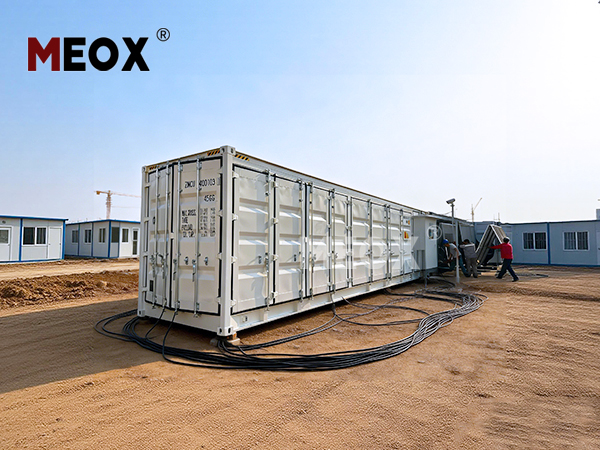
The first thing a seasoned wholesaler notices when stepping onto the ZN MEOX stand is that the mobile solar container on display is not idle. Its 336 high-efficiency 590 W modules are already tracking the low sun, feeding a 215 kWh lithium-iron-phosphate energy storage container that is piggy-backed inside the same ISO frame. This is not a mock-up; it is the MEOX unit that left Suzhou only ten days earlier aboard the MSC Rotterdam, sailed through the Suez, cleared Antwerp customs and then self-powered its own lighting throughout the build-up of the fair. For buyers who have spent years juggling separate procurement streams for PV skids, battery racks and inverter housing, the sight of a single CE-certified, IP65-rated structure that already survived Level 8 typhoon testing and magnitude 8 earthquake simulation offers an immediate re-framing of CAPEX risk. The entire power plant is literally plug-and-play: an IEC 62109-compliant DC combiner box on the front wall terminates into MC4-Evo2 connectors, while the energy storage container side wall carries pre-drilled busbar entries compatible with every major 1500 V inverter brand. No third-party civil works, no separate battery room, no trenching—just roll the box onto six ISO corner blocks, unlock the hydraulic lifting legs, and the array tilts automatically to 25 degrees.
Inside the global leading mobile solar container factory, engineers explain why that simplicity is only possible because every subsystem is born in the same 42 000 m² workshop. The carbon-steel chassis begins life on a five-axis laser line that guarantees 0.5 mm tolerances across the twist-locked footprint; the battery racks are then robot-welded directly onto the chassis so that dynamic loads during highway transport never shear a single busbar. Once the mobile solar container reaches the fairground, the PV racking is unfolded by dual 1.5 kW actuators whose IP67 rating matches that of the modules themselves. Buyers are invited to scan the QR code on any hinge and trace its material certificate back to the mill in Shandong; the same blockchain ledger also carries the UN38.3 test report of every prismatic cell nested inside the energy storage container. In an industry where 5 % cell mismatch can wipe out 20 % revenue over a decade, that level of provenance is not marketing—it is a margin safeguard.
Scale for Wholesalers: 80 kW to 200 kW Mobile Solar Container Configurations
Wholesalers often confess that the hardest part of quoting a solar-plus-storage micro-grid is not the price list but the sizing guesswork. ZN MEOX’s answer is to offer three pre-validated footprints that all fit within a single 40 ft high-cube: 80 kW/110 kWh for telecom towers and remote EV charging, 120 kW/160 kWh for construction sites with three-shift welding loads, and 200 kW/215 kWh for island resorts or mining camps that must ride through three cloudy days. Every configuration uses the same 500–590 W module class that already dominates utility-scale tenders from Morocco to Malaysia, so wholesalers can piggy-back on global volume pricing instead of hunting niche 400 W glass-glass panels. The energy storage container is modular: two 108 kWh racks can be removed in under an hour if the buyer later decides to upsize the PV array, and the empty bay is re-purposed as a cable spool room. Because the DC reticulation is pre-wired to 1500 V, a 200 kW unit can be paralleled with a second mobile solar container in less than forty-five minutes, forming a 400 kW/430 kWh cluster without external switchgear.
Buyers who tour the Suzhou plant in person see how that scalability is baked into the production line. Instead of welding fixed battery shelves, the robotic arms insert sliding DIN rails every 19 inches so that any rack can be repositioned without drilling new holes. Similarly, the PV hinge brackets are riveted rather than welded; when a wholesaler decides to upgrade from 168 to 336 modules, the factory can swap the entire roof in one shift and re-certify the unit for CE the same week. That agility translates into inventory leverage: a distributor in Lagos can stock three base chassis and then customise voltage set-points, colours and monitoring firmware on demand, cutting lead-time from sixteen weeks to six.
From Suzhou to Site: CE-Certified Energy Storage Container Logistics
One persistent myth among European wholesalers is that China Best Mobile Solar Container Exporters must rely on break-bulk shipping that scratches glass and voids warranties. ZN MEOX’s logistics team dispels that myth by loading every mobile solar container as a standard 40 ft high-cube, with the PV array folded flat inside the doors and the energy storage container locked onto the same twist-lock pockets that will later anchor it to the customer’s concrete pad. The result is a freight bill identical to an empty container and a damage rate below 0.2 % over the past 400 units shipped. Customs documentation is simplified because the entire system is classified as a single HS code 8537.10 generator set, eliminating the dual classification headache that often traps PV panels and lithium batteries in separate clearance lanes.
Once the unit arrives at a European port, the buyer has two options. Option A is a turnkey package where ZN MEOX technicians fly in, unfold the array, commission the inverter and train local staff—ideal for first-time adopters. Option B is the “white-label” route: the wholesaler receives the container pre-assembled but with branding panels left blank, ready for their own decals and SCADA integration. Either way, the mobile solar container is designed for fifteen years of service life with only annual torque checks and bi-annual IR scans of the energy storage container busbars. The frame is shot-blasted to Sa 2.5 and coated with a three-layer marine epoxy that survives 1 000 hours of salt spray, while the battery compartment is pressurised to IP65 and fitted with redundant HVAC to keep cells within 15 °C of ambient even in the Persian Gulf.
If you are a wholesaler who needs to quote a 200 kW micro-grid before your competitor does, walk past Hall C65 and watch the MEOX unit feed the fair’s own lighting circuit in real time. When you are ready to reserve serial numbers, visit https://zn-meox.com/ and select “Mobile Solar Container” under the products menu. Remember, every unit leaving our Suzhou yard is more than a product—it is a fifteen-year partnership sealed in Corten steel. Join the network of China Best Mobile Solar Container Exporters and turn the next empty plot of land into a revenue-generating power plant before the next charter rate spike hits.