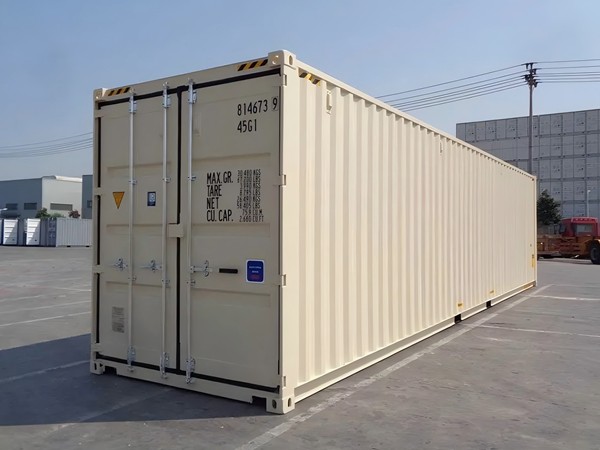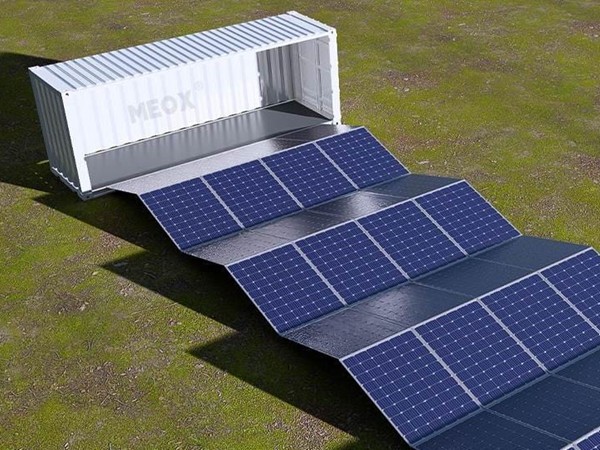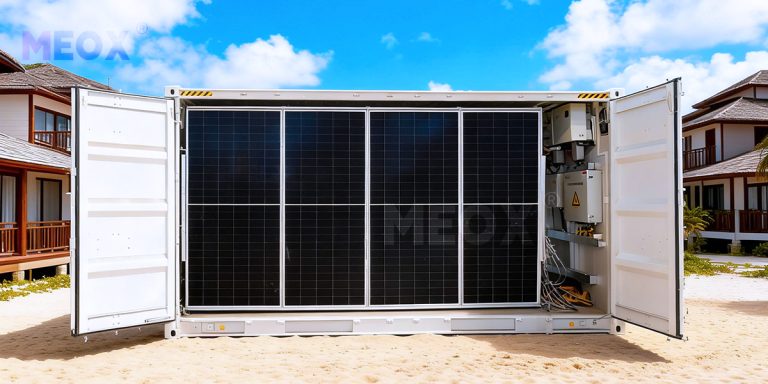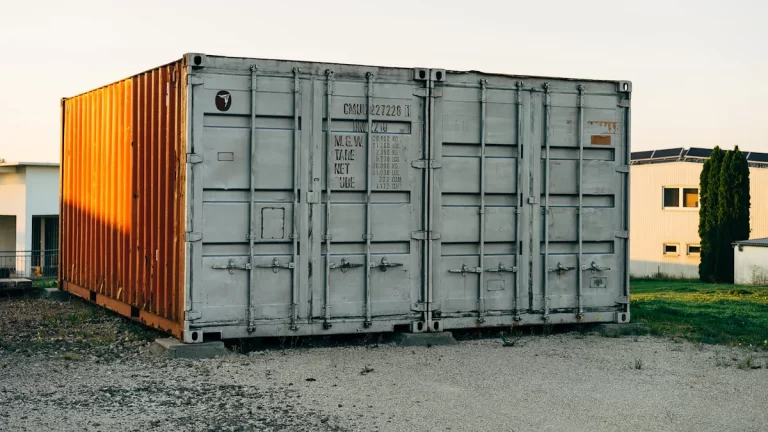
The global tourism sector is transforming. Travelers nowadays don’t just need a room; they want an experience. This has led “unique stays” to be the star category on platforms such as Airbnb and VRBO. One of the most successful approaches has been the container home rental strategy, which turns these industrial structures into real money-spinners for investors. If you blend the industrial look with the speed of relocation, these buildings can be a highly profitable diversification from normal brick-and-mortar real estate.
I am the Senior Modular Housing Consultant at MEOX. Having spent more than 7 years in the prefabricated and modular sector, I am proud to say that I have led the installation of more than 200 container units worldwide on 3 different continents. My role primarily involves finding the perfect balance between structural engineering and hospitality profitability, thus enabling investors to transform empty land into highly profitable rental estates.
Why Container Homes Dominate the Short-Term Rental Market
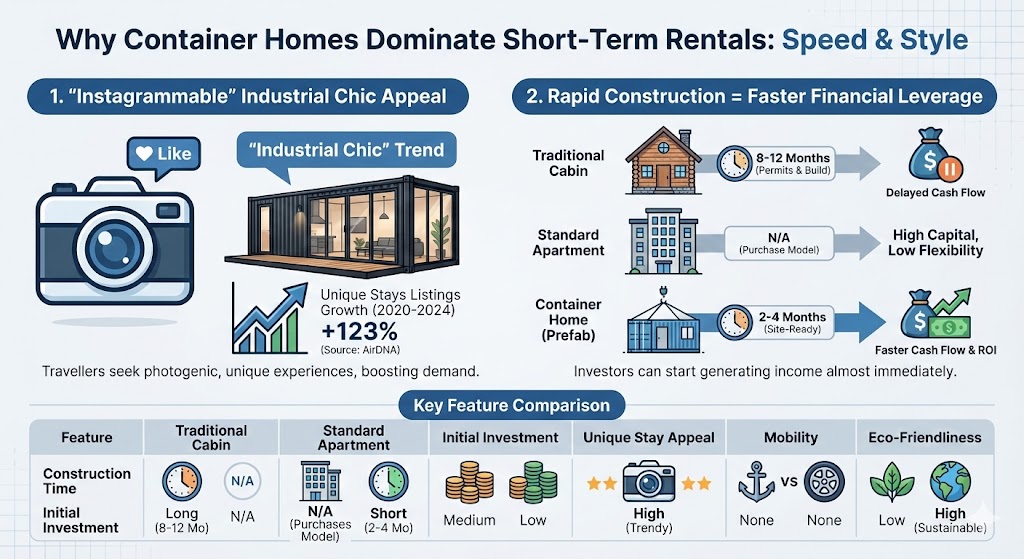
A big part of the lure for a container home as a short-term rental is the fact that it is very “Instagrammable.” Nowadays, travellers are mostly looking for places that will make nice photos, and a shipping container’s smooth, hardy appearance fits perfectly into the “industrial chic” style trend. AirDNA data shows that the number of unique stay listings has grown by 123% from 2020 to 2024, outpacing traditional vacation rentals. This distinctive form of accommodation has been significantly driven by container homes.
Besides that, the rapidity of construction is a giant financial leverage. Whereas it may take a traditional cabin eight months for permission and construction, a prefab container unit can be ready on the site in as little as 10 weeks. This way, investors can start making money almost straight away.
| Feature | Traditional Cabin | Standard Apartment | Container Home |
| Construction Time | 8–12 Months | N/A (Purchase) | 2–4 Months |
| Initial Investment | High | Very High | Moderate |
| Unique Stay Appeal | Medium | Low | High |
| Mobility | None | None | High |
| Eco-Friendliness | Low | Low | High |
Table 1: Comparison of Rental Property Types
Technical Excellence: The Backbone of Your Container Home Rental Strategy
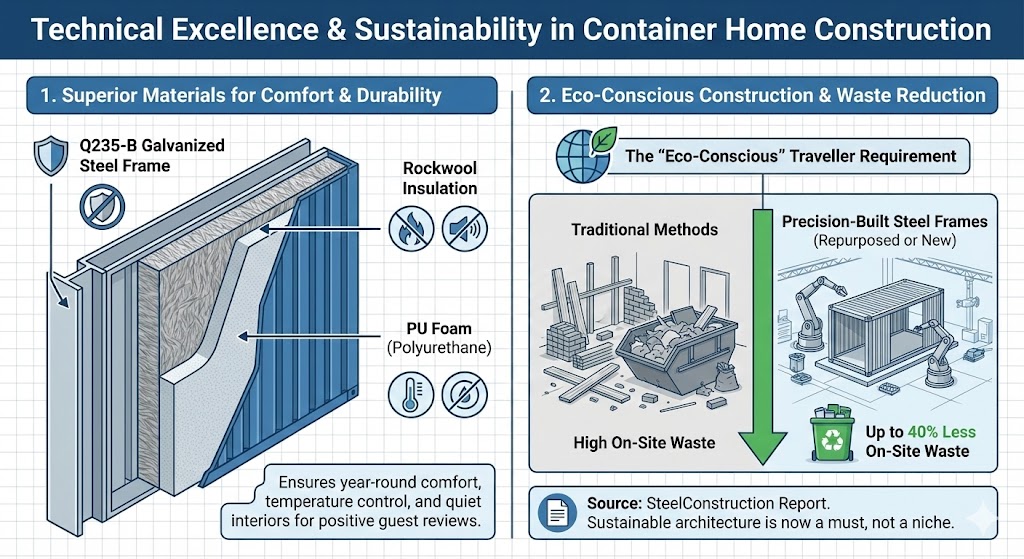
Technically speaking, the differences between container types can be drastic. Clearly, whatever the housing solution is, it has to provide good comfort all year round. The best units are made of Q235-B galvanized steel frame and have Rockwool or PU foam (Polyurethane) type of insulation. In fact, such items also give the advantage of keeping the place quiet, which is one more feature that positively influences guest reviews.
In its report, SteelConstruction highlights that sustainable architecture is no longer a niche, but a must for today’s “eco-conscious” travellers. The use of repurposed or precision-built steel frames can lead to a reduction in on-site waste by up to 40% when compared with traditional methods. These technical advantages form the backbone of any successful container home rental strategy, ensuring that sustainability translates into profitability.
ROI Factors in Your Container Home Rental Strategy
Financial metrics for a modular container house investment, if you think about it, are quite different from those of traditional real estate. Since the initial cost is lower, a “Cap Rate” (Capitalization Rate) is generally higher. While a typical residential rental might have a cap rate of 4-8%, a well-managed and profitable short-term rental container can reach up to 15%, depending on location and available facilities. A well-executed container home rental strategy leverages these financial dynamics, combining lower upfront costs with faster time-to-market.
The Return on Investment (ROI) is boosted by the advantage of “Time-to-Market”. For example, if a conventional construction takes 12 months and a container house takes 3 months, you get 9 more months of the rental income. With an average daily rate (ADR) of $150 and 60% occupancy, that is a bonus of $36,450 in your pocket before even a traditional build is finished.
| Component | Standard Specification | Benefit for Host |
| Frame Material | Galvanized Steel (Q235-B) | Rust resistance & structural integrity |
| Wall Insulation | 50mm – 100mm Rockwool | Superior fire rating and acoustics |
| External Finish | Metal Carved Panels | Aesthetic appeal and extra insulation |
| Flooring | SPC or Solid Wood | Durability against high guest turnover |
Table 2: Estimated Technical Specifications for Rental Units
If you want to get the most out of your modular container home, one of the best ways is to carefully review the current and future expenditures of the house in addition to the initial investment. Based on the data below data we can see that one can expect to quickly recoup the amount of money spent on the project if they decide to use the short-term rental containers for their business in highly tourist-attraction areas.
| Metric | Year 1 (Setup + Ops) | Year 2 (Steady State) |
| Initial Capital Outlay | $85,000 – $110,000 | $0 (Maintenance only) |
| Average Occupancy | 55% | 68% |
| Annual Gross Income | $42,000 | $52,000 |
| Operating Expenses | $14,000 | $16,500 |
| Net Cash Flow | $28,000 | $35,500 |
| Projected Breakeven | ~2.8 Years | N/A |
Table 3: Financial Projections (Estimated 2-Unit Setup)
Case Studies: Container Home Rental Strategy in Action
Case Study 1: The “Desert Cube” – Joshua Tree, USA (2023)
The Problem: The piece of land owned by the investor was situated in a remote area where no water lines were available, and there were extreme temperature changes. Because of high transportation costs, the investor felt that traditional construction was too expensive.
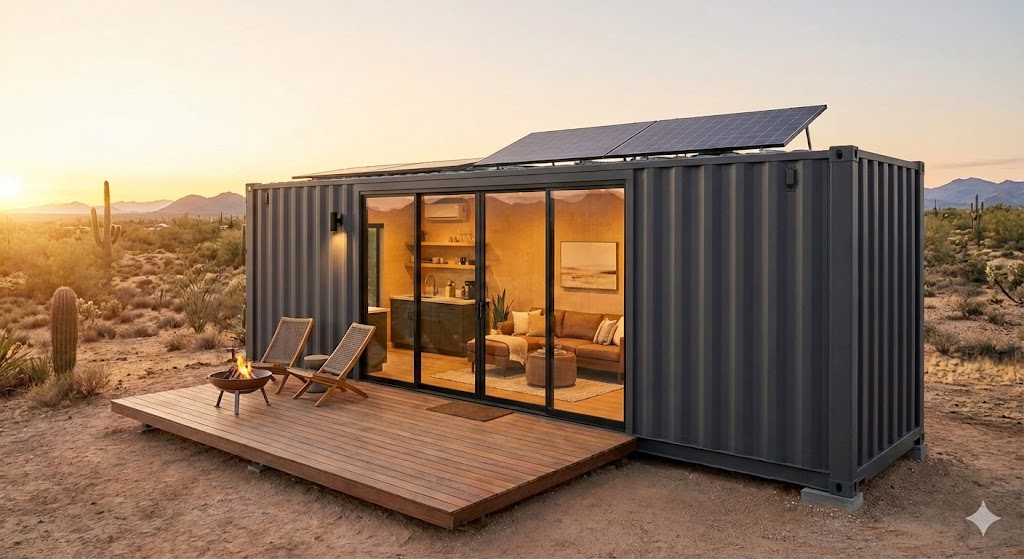
My Involvement: To address this problem, I came up with an idea of a 40ft off-grid container solution. To be able to withstand the desert climate, we fitted the unit with solar-ready roofing and 75mm PU insulation.
The Solution: We released the unit to the customer 90% complete. The “Desert Cube” was already listed on Airbnb just 14 days after the site delivery.
Testimonial: “The team of MEOX converted our non-buildable land into a high earner. We got 85% occupancy in the first 3 months.”
— Sarah Jenkins, CEO of Nomad Stays LLC.
Case Study 2: The “Eco-Lodge” – Queensland, Australia (2024)
The Problem: The resort owner was in a hurry to increase the capacity of the resort before the summer season. At the same time, he didn’t want to compromise on the ‘green’ brand image of the resort.
My Involvement: My first suggestion was a modular container house investment approach where three 20ft units are combined along a central deck. Interiors with sustainable bamboo and low-VOC paints were colours of the day.
The Solution: We’re happy to say that the modular system offered a ‘U-shape’ configuration, which is perfect for the property, as the existing trees were kept there.
Testimonial: “The speed was amazing. We added four guest suites in the time it normally takes to get a foundation poured.”
— Mark Thompson, Operations Manager at Green Horizon Resorts.
To know more about the Container House in detail, please visit our product page here.
Conclusion: Why a Container Home Rental Strategy is Your Best Bet
Putting your money into a container home for short-term rental is a smart decision in today’s world. It combines low initial cost and high market demand. Executing the right container home rental strategy—focusing on quality materials, unique design, and operational efficiency—is what transforms a simple structure into a high-performing asset. When you concentrate on using quality materials and creating a unique design, you will see a profitable rental come to you easily.
Ready to initiate your project? At MEOX, we are experts in producing super-efficient container units customized for the hotel sector. How about I assist you in creating a bespoke amenities checklist that can help increase your next property’s average daily rate?
Frequently Asked Questions (FAQs)
Are container homes safe in extreme weather?
Yes. Container homes, when constructed with top-quality steel and securely anchored to a foundation, are even capable of resisting strong winds and seismic movements at a level which is more than most traditional timber frames.
How do you prevent the “tin can” effect with noise?
Our insulation materials are high-density Rockwool or glass wool, and multi-layered panels are used on the walls. The result is that an acoustic barrier is created, which makes the inside as quiet as an average house.
Do I need a special permit for a rental container?
Different areas will have different permit requirements. Nevertheless, since these are considered to be “prefab” or “modular” buildings, the permit process is typically less complicated than conventional construction.
Disclaimer: The technical data and materials featured in this article are references based on MEOX’s self-made containers. Please be aware that exact specifications, materials, and technical data might vary depending on custom orders, regional regulations, and model updates.
Watch the following video on the installation process of MEOX’s pitched roofing container house: