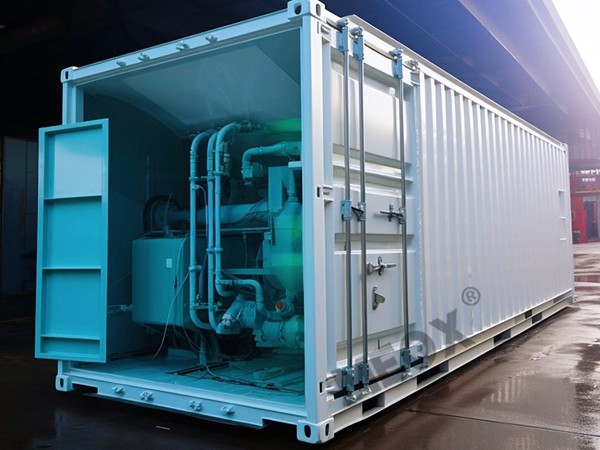
If you inquire as to why one should consider adopting solar container solutions, my response would be-they are portable, sustainable, cost-effective, off-grid, and scalable energy solutions.
Solar container system is the way to go for mobile clinics, vaccine refrigeration, and life-saving medical equipment in disaster areas or rural communities. Such innovative arrangements provide a sustainable, budget-friendly way to areas that lack access to the conventional power grids. If you are running a construction site, a mining operation, or an emergency relief camp, a shipping container solar system is the perfect solution to bring clean energy to the spot that requires it most.
Many people are seeking minimalist homes that not only save them money on energy but also have a minimal impact on the environment. A solar container is exactly what this group of people is looking for, as it provides pollution-free energy and can be moved around without any hassle. It is a sensible way to serve the needs of those living in off-grid areas.
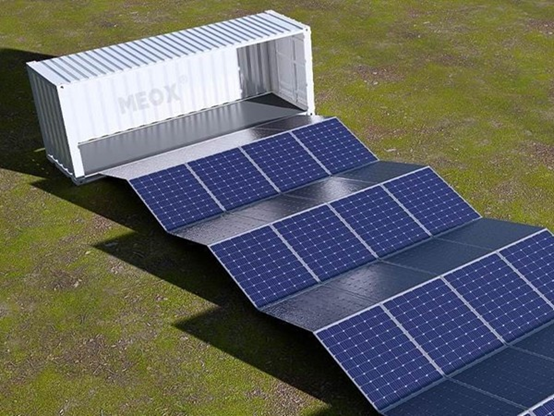
Fig.-1: An unfolded solar container
One of the main reasons why a solar container is becoming a popular choice is the increasing cost of electricity. The solar container system can be used anywhere, be it a city or a remote area; thus, it contributes to energy independence and stable power consumption. Using a solar container in a house is a solution that makes it possible for people to continue their lives in a normal way, even if there is no usual electrical grid.
The trend is also being influenced by the principle of sustainability. A solar container is one way to cut down on carbon emissions, and it also keeps a building’s operating expenses at a low level over the long term. Market studies show that the need for such solutions is growing all over the world at a steady rate as a greater number of households and organizations are choosing to implement low-carbon lifestyles.
The ascent of this solution mirrors a change to energy that is mobile, resilient, and affordable. Having years of experience in dealing with solar container solutions, as the Head of Solar Unit Designer at MEOX, I have the requisite knowledge, skill, and capabilities to provide you with some solar container-related suggestions.
Definition and Key Features
A solar container is a re-purposed shipping container that generates its own power via an on-board solar energy system. The building employs a modular design that permits quick installation and simple moving. Such a design is suitable for both the housing needs of a transient nature and those of a permanent nature in remote or city areas.
A solar container has a number of essential parts. The panels on the solar container are the power generators. The batteries are the storage units for the energy that will be used during the day and night. The inverter is the device that changes the stored energy into the kind of electricity that can be used. The insulation panels are the ones that maintain the inside space at the right temperature, irrespective of whether it is hot or cold outside. The whole thing is, then, a comfortable, efficient, and safe living environment.
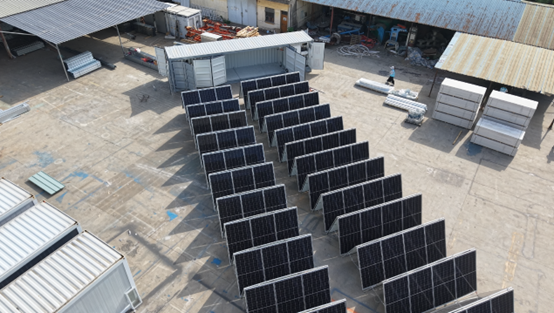
Fig.-2: A 40ft solar container
Such a setup has all the potential to be a successful unit for the building site as well as for the other suggested purposes – a place where people can stay during a crisis, farmhouses, or situations that call for living most of the time off the grid. It is also worth mentioning that the users whose energy supply has to be extremely dependable yet without any connection to the grid will find this kind of container quite suitable due to its mobility and low operating costs.
| Feature | Solar Container | Traditional Container |
| Power Source | Solar energy system | External grid connection |
| Energy Storage | Battery bank | None |
| Mobility | High | Medium |
| Operating Cost | Low | Moderate to high |
| Off-Grid Capability | Yes | Limited |
Table-1: Solar Container vs Traditional Container House
How Solar Containers Produce and Store Energy
A solar container generates power with the help of solar panels that are either installed on the container’s roof or placed externally. The panels capture solar energy and change it into direct current (DC) power. The device can be operated in weak light conditions as well; however, the production will be less. After that, the electric current is the one directed to a charge controller, which is a device that regulates the voltage and safeguards the system against overload.
A solar container is an energy storage unit with a battery bank. The batteries are the source of energy at night and during cloudy days. An inverter changes the DC power that is stored into AC power (alternating current), which is the standard for most appliances. The system is equipped with safety features internally. Among them are surge protection, temperature sensors, and automatic shut-off functions.
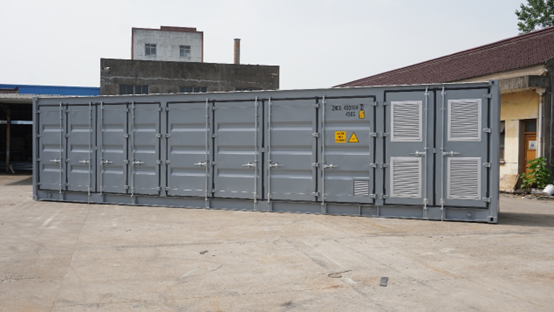
Fig.3-: A folded and locked solar container
An off-grid solar container is powered by very efficient components that have minimal energy loss. Such an arrangement facilitates the users to have a stable power supply even in the most remote and severe areas. The system is designed simply and thus easy to maintain.
Here is a video on the process of solar container establishment and the way it creates electricity:
There are primarily two categories of solar containers offered in the market, namely 20ft and 40ft. Although 10ft containers are occasionally utilized, they are quite uncommon. The key characteristics of the two principal types of solar containers are outlined in the table below:
| Comparison Area | 20ft System | 40ft System |
| Solar Capacity (Power) | 74.34 kWp | 148.68 kWp (approx. double) |
| Number of Modules | 126 (590W each) | 252 (590W each) |
| Total System Weight | 12.5 Tons | 26.8 Tons |
| Deployment Time | 80–120 mins (Unfold/Fold) | 160–240 mins (Unfold/Fold) |
| Required Crew | 6 Persons | 12 Persons |
| Unfolded Footprint | 102m x 6m (approx. 612 m²) | 118m x 12m (approx. 1,416 m²) |
| Inverters | 1 Set (SINENG/Solis) | 2 Sets (SINENG/Solis) |
| Battery Storage Compatibility | 1 Cabinet (125kW / 261kWh) | 1 Cabinet (125kW / 261kWh) |
| Container Length (External) | 6.058 Meters | 12.192 Meters |
| Project Area (Unfolding) | Project Area (Unfolding) | 850 m² |
| Container Weight (Empty) | 3 Tons | 3 Tons |
| Solar Panel Power | 590W per module | 590W per module |
Table-2: Energy Output by Container Size
Advantages of Solar Containers
A solar container is a great way to save money, gain energy independence, and enjoy a low-maintenance period for a wide range of users. In addition, it can be a source of power that is always available during outages and severe weather, and it is environmentally friendly, thus being ideal for residential areas, off-grid locations, and emergencies.
Increasing Demand
According to a report published by Tech Sci Research, the containerized Solar Generator Market was valued at USD 472.97 Million in 2024 and is expected to reach USD 758.56 Million by 2030 with a CAGR of 8.03%. This growth is driven by the rising adoption of off-grid and hybrid power solutions, particularly in remote, disaster-prone, and developing areas.
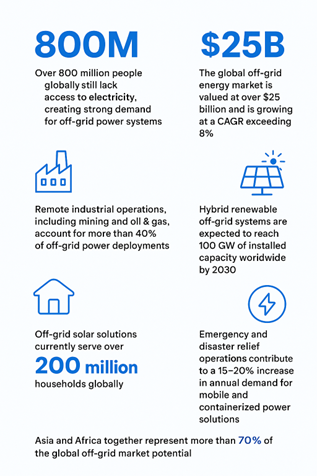
Fig.-4: The overall picture of the increasing demand of solar containers
(Source: https://www.techsciresearch.com/report/containerized-solar-generator-market/30440.html)
Cost-effective
According to Higher Wire, companies using solar-powered containers have reduced fuel consumption by up to 70%, leading to substantial operational savings over time. A solar container is a clean and cheap source of energy for a diverse group of users. It is a major electricity bill reducer as it produces energy right from the sun. It is also a less expensive long-term investment due to very little fuel or maintenance requirements. These saved funds turn the solution into a great offer for families, off-grid holiday places, and provisional job areas. An annual cost comparison is shown below:
| Option | Upfront Cost | Annual Energy Cost | Maintenance | Total Over 10 Years |
| Solar Power | Medium | Low | Low | Low–Medium |
| Diesel Generator | Low | High | High | High |
| Grid Power | Medium | Medium | Low | Medium–High |
Table 3: Annual Cost Comparison (Solar vs Diesel vs Grid Power)
Sustainability
A solar container house is an environmentally friendly way of living. It can still work during power cuts, in case of failure of the power grid or during fuel shortages. Besides that, it can provide electrically safe power even under difficult weather conditions like storms, heat waves, or freezing temperatures. So, it can be metaphorically stated that the house is still living when the mortal ones have died.
Moreover, a solar container is a promoter of sustainable living. In addition, solar-powered containers provide a clean and renewable energy source that supports the reduction of carbon emissions at remote worksites.
Thus, the use of solar-powered containers in remote worksites is becoming a sustainable solution that helps to reduce carbon emissions, making the planet a cleaner place. According to the International Energy Agency (IEA), solar power can reduce CO2 emissions by up to 2.5 gigatons by 2030 (Source: Container Land).
Practical Applications: Where These Containers Are Most Useful!
Among many real-world use cases, a solar container shines by providing clean power and fast deployment. After a disaster, relief teams use it to bring power back to the areas that have been heavily damaged in a short period of time. Construction sites rely on it when the grid is not available. Remote villages get stable power without the need for long electrical lines. Eco resorts pick it to lower their carbon emissions and help the progress of sustainable tourism.
Another option for powering remote camps could be an off-grid solar container, which is also very reliable. These are the reasons why the device is basically perfect: it runs quietly, doesn’t consume much fuel, and its performance is stable even when the conditions are harsh. Its layout is perfect for long field missions or short-term bases.
Real Scenario Examples
Scenario 1: As a result of the severe hurricane on August 12, 2023, the coastal town of Khepupara in Bangladesh went down its power lines and a large number of people (thousands) were left without electricity. Within three hours of the time of the mishap, the rescue squads sent a solar container to a provisional relief centre. The system went live immediately and was able to provide lighting, medical equipment, and communication devices support throughout the day.
At 8:00 PM, the off-grid solar container was still delivering stable power while the repair crews were restoring the main grid. The unit gave three days of safe and continuous power to the people living in the area, which is most important during the recovery period.
Scenario 2: This technology’s application is well known, for instance, after Hurricane Maria, which hit Puerto Rico in 2017 and caused the power grid to collapse. The mountainous, remote areas had no electricity at all for several months. It was very difficult to rebuild power lines due to the terrain, and diesel generators were costly, noisy, and needed a continuous supply of fuel, which was difficult to deliver. Some organizations sent containerized solar microgrids to these villages.
Within a very short time, the solar panels were unfolded by a small team. The unit thus started powering the most essential services that had to be kept going: fridges for medicines (insulin/vaccines), water purification devices, and satellite phone charging stations so that the people could communicate with their families. It was a “pop-up” utility company that did not need fuel trucks and could provide power at any time of the day , immediately.
Conclusion
Solar containers are the answer to the world’s energy problems and will give us power with less operating costs and longer life. In this way, the ensemble supplies steady and effective energy to users in locales that are remote, urban, or where there is exigent locales. These are a visionary step to clean, off-grid habitations. The fact that they are portable, employ green energy, and are dependable from a technical point of view, makes them a significant choice for contemporary dwellings and for situations where there is a need for power in an emergency. MEOX extends these advantages by incorporating superior engineering, sturdy materials, and high-efficiency solar technology. With such characteristics, the unit can be relied on in extreme weather and long-term operations.
MEOX is always at the forefront of the latest innovations in off-grid solar housing with viable and customizable systems. For instance, if you require a system that is mobile, sustainable, and technically reliable, then the products of MEOX would be a good fit.
Get in touch with MEOX for tailored photovoltaic container solutions.