The global market depends on the stamina of hazmat shipping containers to be able to keep the supply chain running. These strong units bring the most dangerous chemicals and waste safely across international borders. However, the sector of heavy industries is at risk today. Clean air and environmental protection organizations want less-polluting logistics that emit less carbon dioxide. The change produces a kind of conflict safety that has to be strictly observed, and the new ecological objectives that have to be achieved.

Fig.1: Some Hazmat Containers are displayed after coatings
It is commonly thought by a lot of businesses that implementing high safety standards will limit the availability of environmentally friendly options. However, this is a misunderstanding. A tough safety standard does not exclude sustainability. Actually, future operations need to have the right lifecycle management and reuse strategies. A shipping container carrying hazardous materials can, in fact, continue to be used for several lifecycles without any damage to its structural integrity. MEOX is the company that is first in line for this environmentally friendly transition. We provide creative and regulation-compliant solutions for the optimal use of containers. Our method guarantees that all regulations are strictly followed while the environmental impact is lessened. As a senior safety consultant with over 6 years of experience in hazardous material transport in MEOX, I have a versatile knowledge of ‘Hazmat Container’ or ‘Hazardous Container’ or ‘DG (Dangerous Goods) Container’, whatever you call it.
This article is a friendly talk between safety and sustainability. We will understand how the use of reusable hazmat shipping containers can be a safe and environmentally friendly way to satisfy the needs of the industry today.
What are Hazmat Shipping Containers?
Hazmat containers have been instrumental in the industrial sector as a safe and regulated facility for storing, transporting, and disposing of hazardous materials. Their design, in effect, prohibits leaks, spills, and the exposure of the contents, thus ensuring compliance with extremely stringent safety standards.
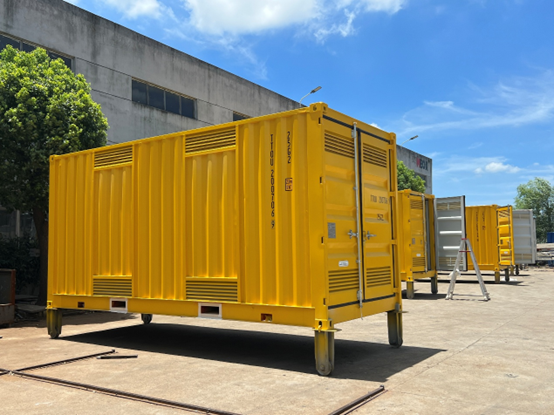
Fig. 2: A 40ft Hazmat Container
Hazmat containers, i.e., hazardous material (Hazmat) containers, are storage units that have been designed specially to carry, hold, and manage dangerous products. These containers are instrumental in safeguarding the handling of harmful substances, such as chemicals, materials that are flammable materials, and biological agents. These hazmat containers are made in a way that they can handle very difficult situations, for example, changes in temperature, changes in pressure, and harsh physical conditions; moreover, they make it possible to prevent leakage or contamination.
Firstly, the function of hazmat containers is to ensure that they are in line with the set standards, for example, those laid down by the U.S. Department of Transportation (DOT) and the International Maritime Dangerous Goods (IMDG) Code. As per these standards, hazmat containers are a key element in the risk reduction process concerning the health of humans, the environment, and property during the transportation and storage of hazardous materials.

Fig. 3: Inside view of a hazmat container
The Intersection of Safety and Sustainability of Hazmat Shipping Containers
Such a container carrying a hazmat shipping container is not merely a basic box or a drum. It is a top-tier engineer vessel, characterized by the Department of Transportation (DOT) and United Nations (UN) standards. In accordance with the 49 CFR rules, these vessels should conform to the stringent Performance Oriented Packaging (POP) standards. They should be able to endure impacts, stacking, and internal pressure without leaking. The producers identify them with particular UN codes, for example, X, Y, or Z, to show their safety level for various packing groups.
For a long time the question of “Make vs. Reuse” was a major point of conflict for companies. On the one hand, ensuring safety by manufacturing a new container for each shipment is very wasteful. On the other hand, reusing containers has always been considered a risky practice or a complicated reasoning. That perception is changing. Today, sustainable hazardous waste packaging is able to close that gap. It provides reliable protection according to the UN requirements, and at the same time, it has a circular lifecycle.
The environmental data thoroughly support the argument. To create a brand-new steel drum, one needs to go through the process of obtaining iron ore and smelting it at a very high temperature. By refurbishing a steel drum, the harsh, energy-consuming processes are completely avoided. The table below clearly shows the huge difference between the products of one-time manufacturing versus professional reconditioning.
| Metric | New Manufacturing | Reconditioned/Reused |
| CO2 Emissions | High Baseline (100%) | 60% – 70% Reduction |
| Energy Usage | Intensive Smelting/Molding | ~33% of New Mfg. Energy |
| Raw Material | 100% Virgin Steel/Resin | <5% (Parts/Paint only) |
| Solid Waste | Significant Manufacturing Waste | ~25% of New Mfg. Waste |
Table-1: Environmental Impact: New vs. Reconditioned Containers
Going green by reusing hazmat shipping containers is no longer merely an environmental decision; it has become a vital part of the strategy. It significantly reduces the carbon emissions of industrial supply chains, and at the same time, keeps the product intact as per the regulations.
Regulatory Framework for Reuse of Hazmat Shipping Containers
Safe procedures are regulated tightly throughout the entire second life process. The Department of Transportation (DOT) provides detailed guidelines in 49 CFR § 173.28. This regulation mainly deals with the different stages of the life cycle of industrial packaging, like reuse, reconditioning, and the remanufacturing. According to it, hazmat shipping containers should not contain any residue resulting from an incompatible reaction. Also, these containers can’t be visibly corroded, ruptured, or structurally damaged in any way. What is more, the act of simply emptying a drum is by no means enough for compliance.
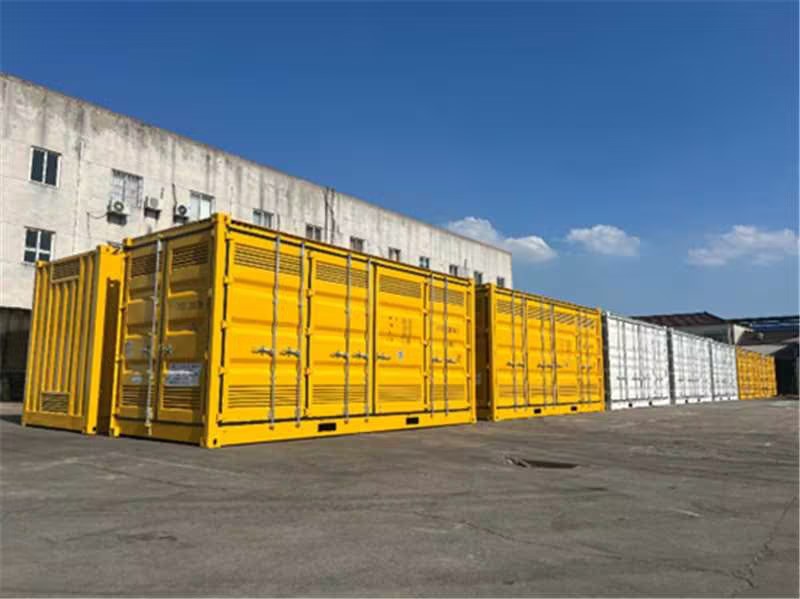
Fig. 4: Hazmat containers can be reused and recycled
There is an essential difference between a drum that is physically empty and one that is “RCRA empty“. The Environmental Protection Agency (EPA) specifies this term very clearly. As per RCRA empty container rules, it is necessary that all waste removal should be done by the standard methods like pouring or pumping. Usually, the remaining residue in a container should not be more than an inch. Knowing this definition is very important for risk management. The initial generator will be the one who will be held responsible until such time as the container fulfills these particular standards.
It is like asking for trouble if someone incorrectly reuses hazmat shipping containers without a complete check. The major hazards associated with this are cross-contamination. For example, residues left over from a first load may react very rapidly with the new materials. Structural failure, on the other hand, is a frightful possibility that a ruptured, weakened drum can become the cause of an accident during the pressurized part of the transport. To stop this from happening, they take it apart as well as thoroughly test it for leaks. Internal air pressure is applied to locate the leaks that are not visible.
Besides, the inspectors check the thickness of the walls very accurately. Metal and plastic drums are required to have a minimum thickness of their walls to be considered durable. In case a drum is found to be good, the reconditioner puts an “L” on it to indicate that it has been tested for leakproofness. MEOX goes first with these safety protocols. We are the ones who make sure that all the hazmat shipping containers in our network are in strict compliance with standards. Safety cannot be compromised in the hazardous materials industry. Only those containers that have been successful in all the tests are allowed to go back to the supply chain. Such a strict framework is what makes hazmat shipping containers a practical, sustainable choice for the future.
| Requirement | Compliance Standard | Regulatory Focus |
| Residue Clearance | Must meet “RCRA Empty” standards (DOT/EPA) | Prevents cross-contamination, limits generator liability |
| Structural Soundness | Thickness Inspection & Leakproofness Test (‘L’ marking) | Prevents structural failure during transport |
| Damage Assessment | No signs of corrosion, rupture, or welding repairs | Mandatory condition for reconditioning/reuse |
Table 2: Summary of Key Reuse Compliance Checks (49 CFR § 173.28)
Practical Reuse Options & Logistics of Hazmat Shipping Containers
Logistics are what ultimately decide whether a reuse program will be successful or not. Closed-loop system is the most efficient manner. In this case, the hazardous material shipping container is the one that is returned to the original filler for refilling. Hence, it totally wipes out the problem of compatibility. In a different way, third-party reconditioners may gather the used units. By using chemical washing, shot blasting, and painting, they bring the drums to a like-new state.
First of all, Intermediate Bulk Containers (IBCs) are the most advantageous ones in this case. Thanks to their modular character, it is quite easy to replace a single bottle while the steel cage is saved. MEOX manufactures containers mainly for durability. We do not compromise the materials that are used, even after they go through several cleaning cycles. By doing so, we extend the lifespan of environmentally friendly packaging for hazardous waste by a great deal. Choosing the right material is the very first step on the way to a successful reuse program. Not all materials are equally good in the reconditioning process.
| Material Type | Reuse Potential | Required Treatment |
| Steel Drums | High | Shot blasting, reshaping, leak testing |
| Plastic (HDPE) | Medium | Chemical wash, neutralization |
| Fiberboard | None (Low) | N/A (Single-use only) |
Table-3: Approved Reuse Methods by Container Material
End-of-Life and Responsible Disposal of Hazmat Shipping Containers
It is a fact that the limitation of a vessel is inevitable. Rust to an extreme degree, holes, or the thinning of the walls are some of the signs that indicate the end of the life of a container. Such a state of a hazmat shipping container is so bad that it is beyond rescue. In order to avoid leaks, it has to exit the fleet at once. The attention is then turned to the industrial container recycling process.
Getting rid of something is not always synonymous with going to a landfill. Steel units are taken to a metal recycling plant after being crushed. Plastic barrels are broken into small pieces for the production of other non-hazmat articles. However, residues are a threat. The “Triple Rinse” method is a must before placing the product on the market. Washing the interior three separate times with a solvent is what it entails. At this stage, the product is considered safe for further processing. In case that cleaning is not feasible, the unit is regarded as a source of hazardous waste. It should be sent to a permitted disposal site that is permitted. MEOX assists clients in making these final decisions. We take care that every hazmat shipping container is retired in a safe manner.
Case Studies
Case Study 1: Reducing Carbon Emissions in Hazardous Material Transportation
Client: Global Chemical Manufacturer, Mexico City
Location: Mexico, North America
When: 2024
Challenge: The client, a large-scale chemical manufacturing company situated in Mexico City, had difficulty in transporting hazardous materials, especially due to the fact that there were high carbon emissions resulting from the production of new hazmat shipping containers for each shipment. The firm was seeking a way to reduce its carbon footprint and, at the same time, make money, while also ensuring that it met the industry regulations.
Solution: MEOX rolled out a sustainable, reusable hazmat container program for the client. Through the use of reconditioned steel drums and Intermediate Bulk Containers (IBCs), MEOX could drastically cut down on the production of new materials, which requires a heavy metal smelting and molding process. So, MEOX employed shot blasting, leak testing, and reconditioning to bring the containers back to a nearly new state, thus making sure that they meet safety standards set by DOT and UN.
Results:
- CO2 Emissions: The client, after switching to reconditioned containers, managed to cut carbon emissions almost in half per unit as compared to new manufacturing methods; the percentage was phenomenal for the client.
- Energy Savings: Due to the energy-efficient reconditioning processes, the client noted a third reduction in energy consumption for each unit.
- Cost Savings: By switching to reusable containers, the client was able to save approximately thirty percent on packaging expenses per year.
Testimonial:
“Working with MEOX has not only helped us reduce our environmental impact but also provided us with a more cost-effective and reliable solution for transporting hazardous materials. Their expertise in container reconditioning and adherence to regulatory standards gave us the confidence to transition to a circular lifecycle for our containers.”
— Michael Bosch, Procurement Manager, Global Chemical Manufacturer
Case Study 2: Implementing a Closed-Loop Reuse System for Hazardous Waste Packaging
Client: PolyClean Waste Management Pvt. Ltd.
Location: Belgrade, Serbia, Europe
When: 2025
Challenge: A popular waste management company servicing the city of Belgrade had difficulties in the process of handling and transporting of their hazardous waste because of limitations set by regulation and their dependence on single-use packaging. The organization was in a position where it had to find a means through which the resuscitation of hazmat containers could be carried out while still observing tightly controlled environmental and safety requirements.
Solution: MEOX created a system for the company that allowed them to return used hazardous waste containers to the original filler for refilling. In this way, they prevented the problem of cross-contamination and also lowered the demand for new containers. MEOX thoroughly inspected the framework of each container and also tested them for leakproofness and conformity to RCRA empty standards, prior to their recirculation. In addition to that, the firm decided to initiate the consumption of IBC containers that can be cleaned and reconditioned up to several cycles without any problem.
Results:
• Reduced Waste: Through the closed-loop system, the client was able to refill almost all of their containers, thus significantly reducing the production of packaging waste.
• Compliance Assurance: The containers complied with all DOT, EPA, and UN regulations, thus the client was free from the risk of compliance issues and fines.
• Sustainability: The client is estimated to have cut their carbon footprint by two third portion in comparison with the use of traditional single-use containers just by reusing the containers instead of discarding them after each cycle.
Testimonial:
“MEOX helped us implement a closed-loop system that not only ensured regulatory compliance but also significantly improved our sustainability efforts. Their thorough inspections and commitment to quality gave us peace of mind knowing that our hazardous waste packaging is safe, reliable, and environmentally responsible.”
— Marko Petrović, Logistics Manager, PolyClean Waste Management Pvt. Ltd.
Conclusion
The industrial challenge is evident: safety and sustainability should go together. Reuses are ensured to be done safely through regulations such as 49 CFR § 173.28. There are very strict protocols set out to stop contamination and the breaking of the structure. Therefore, it is not a compromise when one decides to reuse a hazmat shipping container. It is a conscious, regulatory-compliant decision that helps the circular economy. This model drastically reduces carbon emissions while minimizing industrial waste. MEOX walks clients through this complicated lifecycle. We deliver the best industry expertise in compliant reuse, reconditioning, and disposal. Make the decision that maintains safety and a cleaner future at the same time for every hazmat shipping container shipment.
To understand more about the definitions and features of the hazardous containers as well as the related regulations, please read our other article here.
You might want to discover how the MEOX brand meets your needs with their environmentally friendly, reusable hazardous material container solutions that are also safe. We are the ones who care for you to make a comfortable transition to a future that is more sustainable and, at the same time, provides safe and efficient management of hazardous materials.