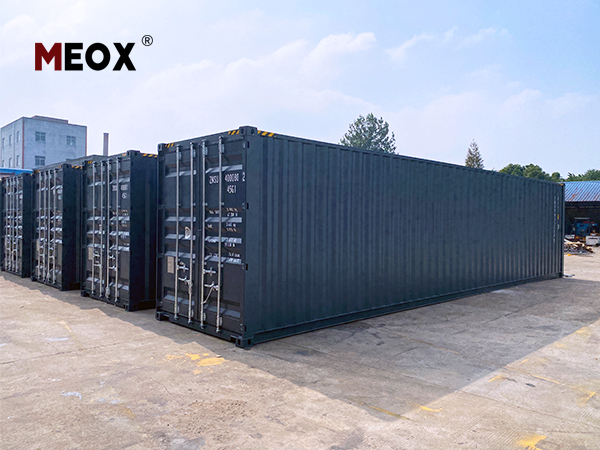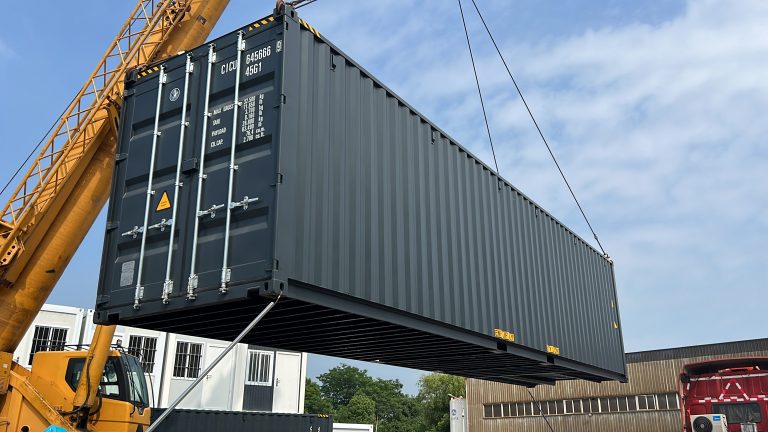
In large-scale industrial operations, the quantity of volatile materials is often more than what standard storage units can handle. When the amount of chemicals, paints, or lithium batteries is extremely large, using a 40ft hazardous goods container is a logistical decision. These big-size containers not only have the structural strength to hold heavy stock but also comply with the most stringent safety regulations set by international law.

Introduction: The Necessity of a 40ft Hazardous Goods Container for High-Capacity Storage
The selection of a 40ft hazardous goods container is not merely a matter of having extra floor space. It is a matter of integrated risk management. In fact, numerous facilities experience an increase in the complexity of fire monitoring and suppression when they store their hazardous materials in numerous small units. A large-scale, single, engineered unit provides the safety protocols to be streamlined and the inventory access to be significantly more efficient.
I have been working as the Senior Technical Consultant at MEOX for more than 7 years. My professional experience has been mainly focused on industrial container solutions, where I have been engaged in the implementation of designs and industrial container solutions. I have personally overseen the commissioning of over 50 large-scale storage projects, bringing them to successful completion. Every 40ft hazardous goods container that MEOX produces is not only tested but certified to be far beyond the global safety standards.
Technical Specifications of the 40ft Unit
The physical strength of a 40ft hazardous goods container must be much greater than that of a normal shipping box. Since the length is increased, the structural integrity plays a very important role in making sure that the container does not bow or fail under heavy chemical loads.

Physical Dimensions and Load Capacity of the 40ft Hazardous Goods Container
According to our technical manufacturing data, these units feature a structure that can easily endure heavy weights and are also resistant to different environmental stressors.
| Technical Data | 40ft Hazardous Goods Specification |
| External Dimensions | 12192 * 2438 * 2896 (LWH/mm) |
| Container Weight (Empty) | Approximately 7.0 Tons |
| Total Operating Weight | Up to 26.8 Tons |
| Operating Temperature Range | -30°C to +60°C |
| Wall Reinforcement | 3.0mm+ High-Tensile Steel |
Advanced Features: Integrated Spill Containment for 40ft Units
Integrated spill containment for 40ft units is a crucial part of large-scale storage. When you store hundreds of litres of liquid chemicals, the secondary containment sump needs to be very large. The Environmental Protection Agency (EPA) states that secondary containment should have the capacity to hold 110% of the largest container stored volume.
Comparison: 20ft vs. 40ft Hazardous Goods Container
The decision whether to use a 20ft or a 40ft hazardous goods container is influenced mainly by your inventory turnover and the size of your site.
| Feature | 20ft Hazardous Unit | 40ft Hazardous Unit |
| Storage Surface Area | ~14 Square Meters | ~28 Square Meters |
| Ventilation Needs | Natural or Single Forced | Dual-Zone Forced Ventilation |
| Spill Sump Volume | Standard Capacity | High-Exchange Deep Sump |
| Best For | On-site usage/Limited stock | Centralized Hub/Bulk Stock |

High-Capacity Flammable Liquid Storage Solutions
Industries that need to store large volumes of flammable liquids are among the main beneficiaries of the 40ft unit, which has some great features. One of the things that makes these containers very practical is that most of them come with “Open Side” doors. This feature enables the loading of pallets directly to the unit without the need for heavy manual work. It is well known that the causes of accidents in the industry include handling hazardous drums, so the risks are reduced when forklifts are used to load.
The International Organization for Standardization (ISO) acknowledges that modular steel units have significantly higher blast resistance than regular warehouses. The container is designed so that pressure-relief panels on the roof allow the release of an internal explosion upward instead of outward. It is like the container has been built to take the blast in the roof direction.
Real-World Case Studies of the 40ft Hazardous Goods Container
Case Study 1: Centralized Chemical Hub
Location: Riyadh, Saudi Arabia
Time: March 2024
Participants: Mr. Omar Al-Fayed, Operations Director at Desert Petrochem.
The Problem: The client had a setup consisting of five separate 10ft units, which resulted in inconsistent monitoring and temperature control.
The Solution: I headed the effort to substitute the separate units for one 40ft hazardous goods container, only with centralized monitoring. Mr. Al-Fayed said, “Putting all our Class 3 flammables together in one 40ft MEOX unit cut our inspection time by 60% and also made our cooling costs more stable.”
Case Study 2: European Battery Energy Project
Location: Hamburg, Germany
Time: October 2024
Participants: Hans Müller, Lead Engineer at EuroGrid Power.
The Problem: The client had to install a huge bank of lithium-ion batteries. So, they needed a unit that could stop thermal runaway spreading.
The Solution: We sent out a custom 40ft container fitted with A1 grade rock wool insulation and an automatic fire suppression system. I was closely involved with the sensor-based cooling integration. Mr. Müller remarked, “The structural reinforcement and the energy efficiency of the MEOX design gave us the safety certificate required for our inner-city location.”
Conclusion
The 40ft hazardous goods container is a perfect answer to the storage issues of large industries. It offers ample space for bulk inventory and is equipped with top safety features for risky environments. Purchasing a 40ft unit with built-in spill containment is a way for companies to safeguard their employees, assets, and the natural surroundings.
When your business keeps growing, and its current storage can no longer hold more, it’s the right time to go for a secure scale-up. At MEOX, we produce top-quality 40ft hazardous goods containers that are designed precisely for your technical needs. Give us a call for a chat about your high-capacity storage requirements.
Frequently Asked Questions (FAQs)
Is a 40ft Hazardous Goods Container harder to keep cool than a 20ft unit?
Not necessarily. A 40ft hazardous goods container is normally provided with dual-zone Ex-rated HVAC systems for the whole length temperature uniform control, even though it is a bigger volume.
Can I store different types of chemicals in one 40ft Hazardous Goods Container?
Yes, only if they’re compatible.Even in a 40ft hazardous goods container, non-compatible chemicals must be separated by fire-rated partitions to meet safety regulations.
Does the 40ft Hazardous Goods Container require a special foundation?
A 40ft hazardous goods container needs a level concrete or reinforced foundation for stability and proper door operation.
Disclaimer: The technical data and materials mentioned in this article are based on MEOX’s self-manufactured containers; the specifications, materials, and technical data may vary.
Watch the following videos on “Maximize Container Space with Precision-packed Hazardous Waste Containers”: