Carriage of perilous substances cannot be accomplished without due diligence and proper handling. Any one mistake in declaring a flammable liquid drum or even a cracked seal from a container may convert an ordinary sea journey into a fire or spill or even lead to death. This is why the 20FT dangerous goods container has become a separate product category in the market, which has been in particular designed and built to limit the spread of danger instead of just conveying the cargo.
This guide explains what a 20FT dangerous goods container is, how it is built, which regulations govern its use, and how a real project put one to work. Wherever technical claims appear, they are drawn from a manufactured 20FT Dangerous Goods Container product line, so you can see exactly what “compliant” looks like in practice.
When the article speaks to regulations, these regulations are given per what is stated in their official scope as published by ISO and IMO. Container-related data (sizes, weights) are derived from specification documents of MEOX, and it is highly recommended to check data against the information given in the data plate of the unit before shipment.
What Makes a 20FT Dangerous Goods Container Different
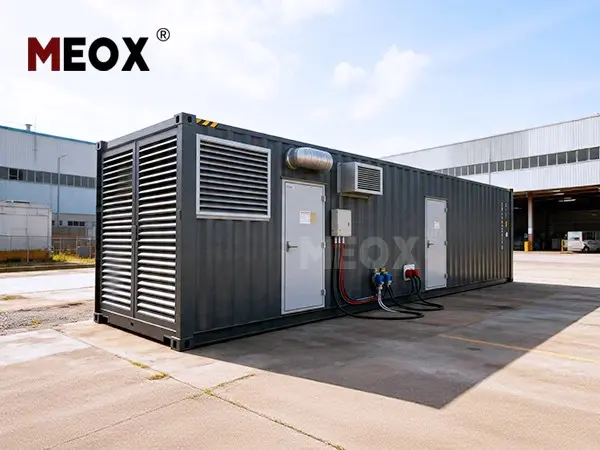
A regular dry container transports boxes. In contrast, a hazardous material container, besides carrying dangerous goods, contains the threat and because of this is designed as a containment unit. The unit is usually set up in 20′ X 8′ x 9’6″. High-cube dimensions have been used to give as much inside clearance as possible for drums and IBCs. Some manufacturers also offer 8’6″ tall version of low-ceiling ones based on the build method employed. You need to check with your supplier how tall externally the unit really is – this height influences stowage planning of the container ships and inland clearance of vehicles.
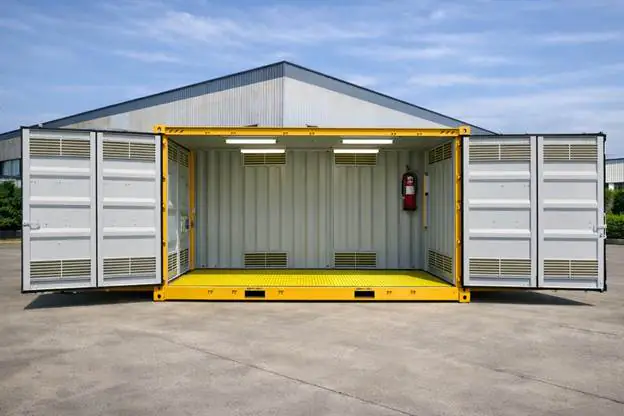
A containment basin or “a drywell” on the floor prevents any liquid substance, even a leaking barrel, from spreading in the surrounding area. A chemical drainage port allows emergency workers to dispose of hazardous liquid content safely rather than leaving the doors wide open where there might be a spill. Having two access doors on the side enables unloading and loading as well as reducing handling that is usually responsible for the damage in the first place, while an emergency exit hatch brings personnel with an alternative escape route if the primary door gets blocked.
The structure comes with heavy duty locking rods and corner castings, indicating among other things that such a container can still be safely handled and stacked together at the port using a craning or other equipment without compromising the integrity of the unit due to its special internal features. All what I just said features are not there only as an aesthetic choice or for decorative purposes but actually they all correspond to various failure causes, which hazardous cargo may generate.
Specifications at a Glance
| Parameter | Metric | Imperial |
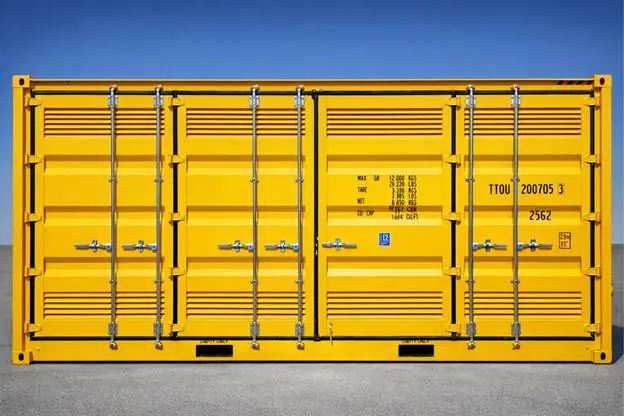
| Max. Gross Weight | 12,000 KG | 26,455 LBS |
| Tare Weight (±2%) | 3,350 KG | 7,385 LBS |
| Max. Cargo Weight | 8,650 KG | 19,070 LBS |
| Cubic Capacity | 35.1 m³ | 1,241 FT³ |
The rated weight changes per the build type, makers give maximum overall weight for two different sizes of dangerous goods containers, the first as light as 12,000 KG only and the other as heavy as 28,230, 30,480 KG if fully built with CSC plated. This variation is such a big thing that it can even influence one’s route planning, so it’s advised that you, instead of trusting a general specification sheet, have the CSC safety certification plate rating and cargo securing manual sent for the exact unit that you were offered.
Certification and Regulatory Compliance
Compliance is why to use a purpose-built 20FT dangerous goods container. Through Independent third-party verification which confirms the container’s production are in line with ISO 16106:2020. This is an international standard that implements ISO 9001 quality-management principles to the production of packaging, IBCs, and large packaging for dangerous goods. The certification indicates that there is regular manufacturing quality with checks rather than a one-time structural test, it works together with but does not replace the container’s structural rating under the CSC (Container Safety Convention) and ISO 1496 series which regulate the box’s load-bearing and stacking performance respectively.
The IMO rules on dangerous goods also contain a dangerous goods code, named International Maritime Dangerous Goods Code that govern the maritime transport of dangerous goods, is updated by the International Maritime Organization. It was devised for increasing the safety level and harmonizing the safe carriage of dangerous goods in seaborne transportation and preventing pollution as well, its provisions have been made mandatory through the SOLAS Convention since 1 January 2004 (IMO, imo.org).
A certified 20FT dangerous goods container is a part of meeting this guideline; other requirements include proper classification, packaging, and documentation. The consequences of skipping any of these steps are not just theoretical. Vessel fire events continued at almost a decade high level in 2025, and misdeclaring cargo, Mostly Lithium-ion batteries and chemicals, are still among the chief polluters (Allianz Commercial, Safety and Shipping Review 2026, via GCaptain). Although certified dangerous goods container cannot correct an incorrectly declared shipment, it minimizes risk of a major hazard by removing a major potential problem point from an already unforgiving workflow.
Hazard Classes and Handling Protocol
| Hazard Class | Compatibility | Notes |
| Class 3 (Flammable liquids) | Supported | Bunded floor limits spill spread |
| Class 4–9 (Corrosives, oxidizers, misc.) | Supported | Check IMDG segregation rules for mixed loads |
| Class 1 (Explosives) | Excluded | Not compatible with standard DG container design |
| Incompatible mixtures (e.g., oxidizers + flammables) | Excluded | Must ship separately per IMDG stowage rules |
It is important that you follow the right sequence of actions on how to get out of the place in case of any kind of danger situation, besides having safety equipments. In the first step, you should isolate the place of danger, leave the premises through a designated emergency exit, and use the bundled floor to contain any kind of spillage with the spillage drain valve being opened for draining only when that area is cleared to be safe. The right way out to tackle any fire, i.e. extinguishment with appropriate means, is determined only and solely by hazard class and UN number concerned: – some chemicals burn badly with water whereas others need it, Because of this the firefighters should consult EmS Guide under Emergency Response Procedures for Ships Carrying Dangerous Goods, that is part of IMDG Code – not relying on any standard instruction. Besides that, every unit must be provided in all times, with the Emergency contact placards and the Dangerous Goods Declaration of the shipment for the ease of the personnel and the authorities when they contact or deal with the situation.
Case Study: Moving Industrial Solvents Without a Single Delay
A chemical distributor preparing a multi-port shipment of flammable industrial solvents faced a specific problem. Their existing containers lacked spill containment, which meant every port they touched required extra inspection time and, at two stops, additional documentation before cargo could even be unloaded.
MEOX supplied 20FT dangerous goods containers built with the bunded floor, drainage valve, and dual side-door configuration described above, each accompanied by ISO 16106 and TUV certification paperwork bundled for customs review. The certifications provided officials with the necessary tools to instantly check if all requirements are met, eliminating the need for extra testing documents. The shipment departed all three ports at the planned time with no delay, and the company claimed that nothing was spilled along the entire path. It was even discovered that, besides the main advantage, another one which may seem minor but is Even so helpful was saving on loading time thanks to In reality side-entry doors were used so that the forklift operators were no longer required to reposition the containers for back door loading.
Frequently Asked Questions
Q: Why choose a 20FT dangerous goods container over a standard dry box for hazmat cargo?
A: A standard container has no containment, drainage, or emergency egress features. A 20FT dangerous goods container is purpose-built with a bunded floor, drainage valve, dual side doors, and an escape hatch, and it carries ISO 16106 certification that a standard box cannot offer.
Q: Which hazard classes can a 20FT dangerous goods container carry?
A: Classes 3 through 9 are generally supported, covering flammables and corrosives, among others. Class 1 explosives and incompatible mixtures such as oxidizers stored with flammables are excluded. Always verify segregation requirements against the IMDG Code before booking.
Q: What is the maximum payload of a 20FT dangerous goods container?
A: Standard units are rated for a 12,000 KG max gross weight, with roughly 8,650 KG of that available as cargo weight once tare weight is subtracted. Dense chemical loads that would exceed this should be discussed with the manufacturer, since upgraded-capacity builds are available.
A Note on Sourcing
Not every dangerous goods container on the market carries genuine third-party certification, and the gap only becomes visible during an audit or, worse, an incident. Buyers evaluating a 20FT dangerous goods container for sale should ask for TUV documentation and ISO 16106 test records up front, and should compare it against related options such as a 10FT Dangerous Goods Container for smaller loads, a Double Door Container for general access-heavy cargo, or a DNV Offshore Container where offshore certification is the priority.
Reviewing the full Dangerous Goods Container range is a reasonable starting point before narrowing down to a specific size.
If your operation ships hazardous cargo regularly, the container itself should not be the weak link in your compliance chain. MEOX manufactures certified 20FT dangerous goods containers with the containment, access, and safety features hazmat shipping demands, and the team can help match a configuration to your specific cargo profile. Reach out for a quote and certification documentation before your next shipment.
Disclaimer
The technical data, specifications, and materials referenced in this article are based on MEOX’s own manufactured container products. Specifications, materials, and technical details may vary by project and are subject to change; always confirm current specifications directly before purchase.
To see how these containment and safety features work in practice, watch the following video on MEOX’s Dangerous Goods Containers Introduction: