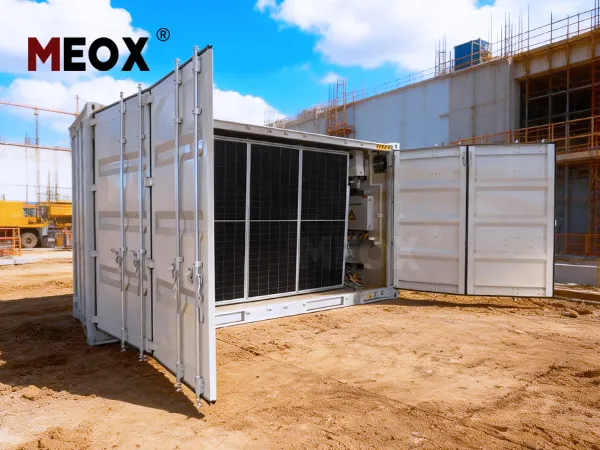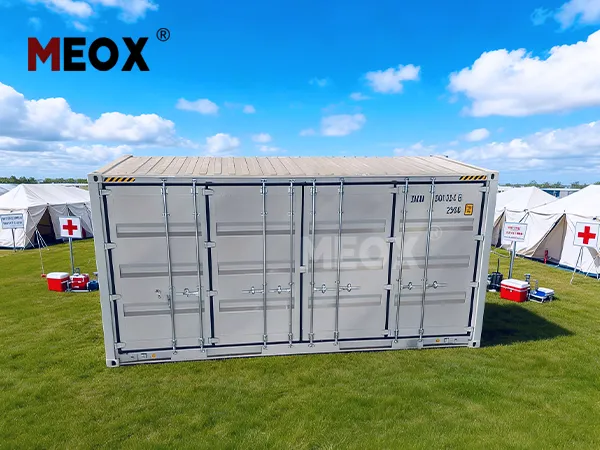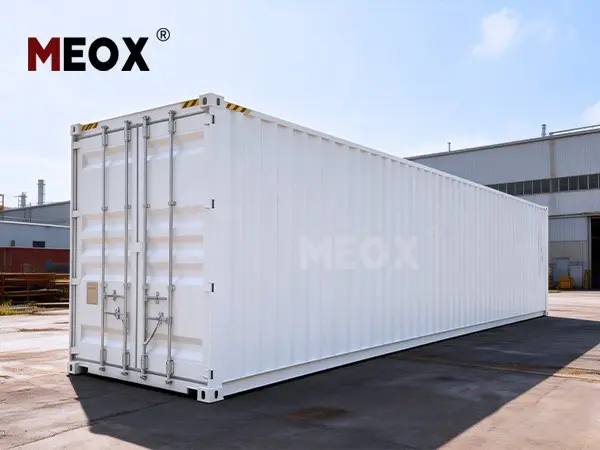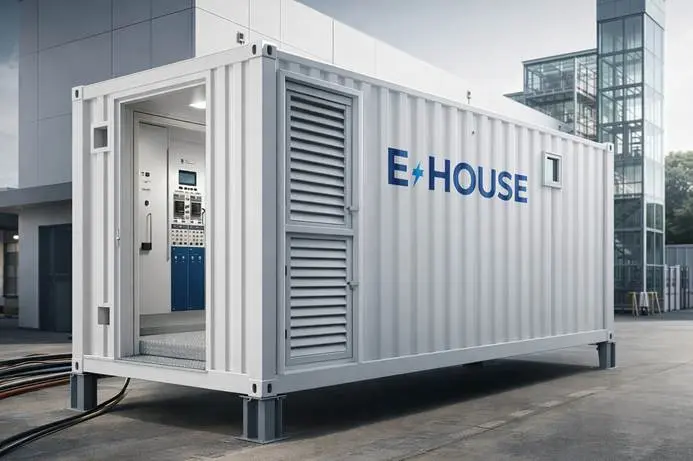
A double door container is a type of container which comes fitted with an additional set of doors opposite the normal end. This feature permits the flow of goods in and out without opening the additional doors. In case two units are parked next to each other, this will make a certain pathway for workers while moving from one section of the site to another to work on something. The design enables handling and storing things which are either too long or too bulky to be moved through a single door opening.
This guide walks through what a double door container actually is, how it is built, where it earns its keep on real projects, and what to check before ordering one. Specifications and imagery are drawn from the MEOX Double Door Container product line.
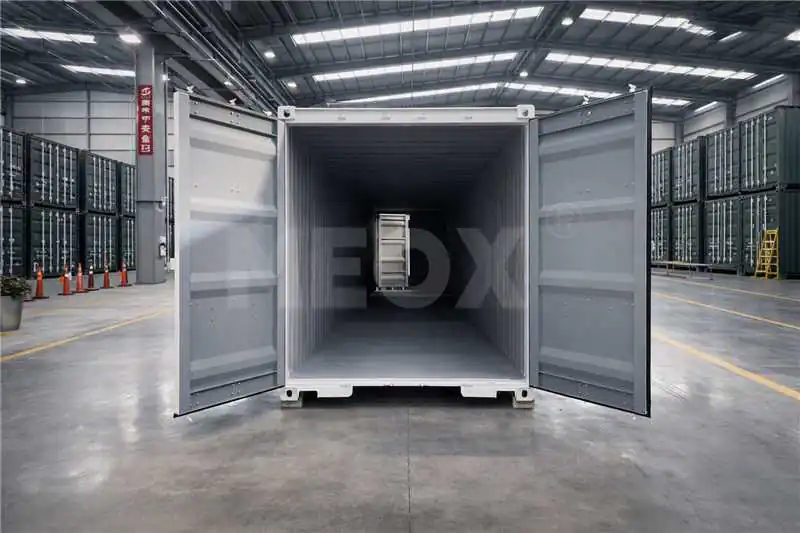
What Is a Double Door Container?
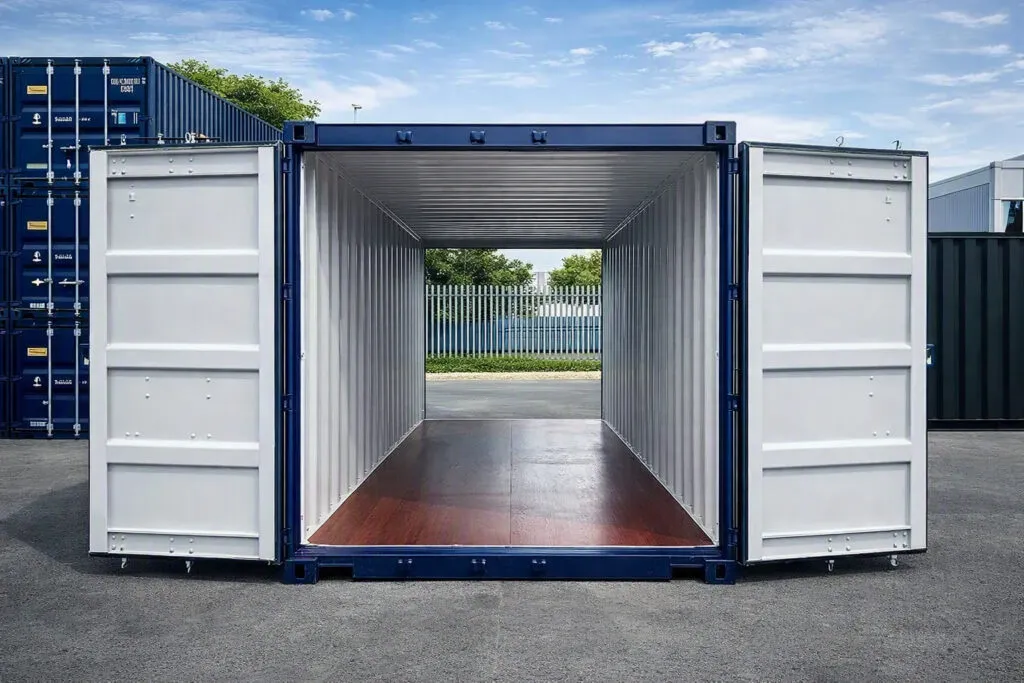
As a tunnel container, a double door container is constructed with full-length doors welded at the position of one of the end walls and not just one. When both doors are opened, light passes straight through this unit; hence the name of a tunnel container. The passage can also be used for loading cylindrical or oversized cargo in the middle of the container without needing to turn the item inside the box.
The same piece of equipment operates in reverse as well. When both doors are closed, it acts as two separate storage units that can be accessed independently from either side, thus enabling two work teams to work independently without disturbing one another. Since the corner castings and locking points are located on both ends, these units can stack and interlock with other units, which is particularly useful on sites where there isn’t much available space and where it is important to connect units into a continuous corridor.
It’s important to highlight that double-door containers and side-opening containers are two different kinds of containers meant to address the same access problem. Double-door containers work along the length of their travel from one end to another, while side-opening containers work along their length of travel. The choice between one or the other depends on how the cargo must move with respect to the long axis of the container.
Key Features of the Double Door Container
After the second set of doors, something distinguishes a specially designed tunnel container from an ordinary box which has just had its ends cut off.
| Feature | What It Means for the User |
| Doors at both ends | Load and unload from either side; use as a pass-through corridor |
| 20FT, 40FT, and 40FT High Cube options | Match the container to cargo length and site clearance |
| ISO and CSC certification | Cleared for road, rail, and sea transport without extra paperwork |
| Reinforced locking points | Multiple containers link end to end for extended storage runs |
| Full customization | Colors, branding, interior fit-out, and insulation available on request |
The unit also keeps the structural strength of a standard ISO box. The added end doors do not compromise the frame, because the corner posts and roof rails are reinforced to carry the same stacking and racking loads as a conventional single-door container.
Double Door Container Specifications
Specifications may differ a little bit from one manufacturer to another, but the following table indicates standard specifications of a 20ft double door container and door and frame specifications of 40ft and 40ft high cube containers.
| Parameter | Specification |
| External dimensions (L x W x H) | 6.058m x 2.438m x 2.591m |
| Internal dimensions (L x W x H) | 5.898m x 2.352m x 2.393m |
| Door size (W x H) | 2.343m x 2.28m |
| Frame material | SPA-H / SM50A side rail, SM50A / SS41 end rail, T1.6 SPA-H roof |
| Paint thickness | 140 microns |
| Tare weight | 2,000 kg |
Those looking for an alternative between the two options should consider that the added length is primarily useful for longer pipe runs, coils, or cables, while the high cube versions offer additional height to accommodate taller machinery and rack systems. Anyone weighing container length against site access should also look at the Side Opening Shipping Container, which trades end-loading for full-length side access and suits wider or palletized cargo better.
Where Double Door Containers Are Used
The tunnel-style layout suits a narrow but recurring set of jobs, and it tends to show up wherever cargo length or site geometry rules out a standard box:
- Loading long, rigid cargo such as steel pipe, structural beams, cable drums, and rebar bundles from either end, so cranes and forklifts can approach from whichever side is clear
- Acting as a covered walkway or safe passage between two work zones on a construction site, which is the origin of the “tunnel container” nickname
- Splitting one unit into two independently accessible storage bays, back-to-back, useful when two trades need separate lockable space
- Linking multiple containers end to end to create an extended, continuous storage run where footprint is tight
- Serving as a base shell for a custom container conversion that needs dual access, such as a mobile workshop, inspection point, or field office with distinct entry and exit doors
Because the design is really a variation on a standard freight container, most of the fit-out options available on other MEOX products, including insulation, shelving, and electrical rough-in, can be applied to a double door unit as well.
Standards and Certification
A double door container built for export needs to clear the same testing regime as any other freight container. ISO 1496 specifies the basic specifications and testing requirements for series 1 freight containers, covering closed, vented, ventilated, and open-top types suitable for road, rail, and sea transport, including interchange between these modes, as set out by the International Organization for Standardization. The need for interchange enables a tunnel container to travel from a manufacturing facility in China to a ship, and then to a freight vehicle at the destination, without requiring recertification at any point along the way..
On top of ISO 1496, containers built for international trade typically carry CSC (Container Safety Convention) approval and classification society sign-off from bodies such as ABS, BV, GL, or CCS. These marks confirm the unit has passed structural and lifting tests, which matters for a tunnel container given the added stress the end-door cutouts place on the frame compared with a single-door design.
Growing Demand for Long-Cargo Container Solutions
Demand for tunnel-style loading is tied to a broader trend in industrial cargo. Grand View Research estimated the global steel pipes and tubes market at USD 137.62 billion in 2025, projecting growth to USD 209.89 billion by 2033, driven largely by infrastructure and energy pipeline projects across Asia Pacific and other developing regions. Each segment of that particular pipe will have to travel via some means of transport – be it road, rail, or sea. If containers are loaded from only one side, they can hinder shipments as soon as the length of the cargo exceeds the inner dimensions of the container. As a result, procurement specialists have started to opt for double door containers instead of ordinary ones when dealing with shipments of pipes, coils and beams. The same idea works for renewable energy projects and modular construction, where long structural elements have become extremely common.
Double Door Container vs Other Specialized Containers
| Container Type | Access Points | Best Suited For |
| Double Door Container | Both ends | Long pipe, coil, and beam cargo; site pass-throughs |
| Side Opening Shipping Container | Full side length | Bulky pallets, machinery, wide-format goods |
| Standard Dry Container | One end only | General cargo, boxed and palletized goods |
Some projects call for a hybrid approach. A dangerous goods shipment that also involves long, rigid items, for instance, may need a Dangerous Goods Container built to a different compliance standard than a tunnel container, so it is worth confirming cargo type and hazard classification before finalizing container selection. Offshore projects, meanwhile, often require a DNV Offshore Container rather than a standard tunnel unit, since lifting and crane-transfer certification takes priority over end-to-end access.
Case Study: Solving a Pipe-Storage Bottleneck on a Coastal Infrastructure Project
A Southeast Asian civil contractor working on a coastal pipeline extension faced a recurring delay: the site’s laydown yard had no room to store full-length steel pipe sections horizontally, and the standard single-door containers already on hand meant every pipe had to be walked in and out from one opening, slowing the crew down and occasionally scraping the pipe’s protective coating against the door frame.
MEOX supplied a run of 40 ft double-door containers configured with reinforced door hinges and a raised internal guide rail to keep pipe sections centered during loading. The crews were able to simultaneously load and unload units thanks to having doors at both ends, which resulted in a halved handling time with regard to the units. Using a single-door container previously used in this project made this possible. The units were also arranged in a line along one edge of the yard, creating a covered corridor that protected the pipes from the rain. The contractor mentioned at the end of the project that he no longer had to worry about scheduling pipe handling once the tunnel containers were put into place.
Frequently Asked Questions
Q: What is the difference between a double door container and a standard shipping container?
A: A standard shipping container has one set of doors at a single end, while a double door container has doors at both ends. That second opening lets cargo pass straight through the unit and allows loading or unloading from either side, which a single-door box cannot do.
Q: Can a double door container be used for storage, not just transport?
A: Yes. With both doors closed, a tunnel container can function as two separate storage compartments, each accessed from its own end, or as one long enclosed space when both doors stay open on demand. Many buyers use the same unit for both purposes across its service life.
Q: Are double door containers certified for international shipping?
A: MEOX double door containers are ISO and CSC certified, and built to classification standards recognized by ABS, BV, GL, and CCS, so they can move by road, rail, and sea without additional certification at each leg of the journey.
Get a Custom Double Door Container Quote
A double door container earns its cost back fastest on jobs where cargo length, site access, or storage layout would otherwise slow a crew down. ZN MEOX manufactures 20ft, 40ft, and 40ft high cube double door containers in-house, with customization available for color, branding, interior fit-out, and locking hardware. Reach out with your project dimensions for a specification sheet and a quote.
Disclaimer
The technical data, dimensions, and materials referenced in this article are based on ZN MEOX’s own manufactured double door container products. Specifications, materials, and technical details may vary by order and are subject to change; buyers should confirm exact parameters with ZN MEOX before finalizing a purchase.