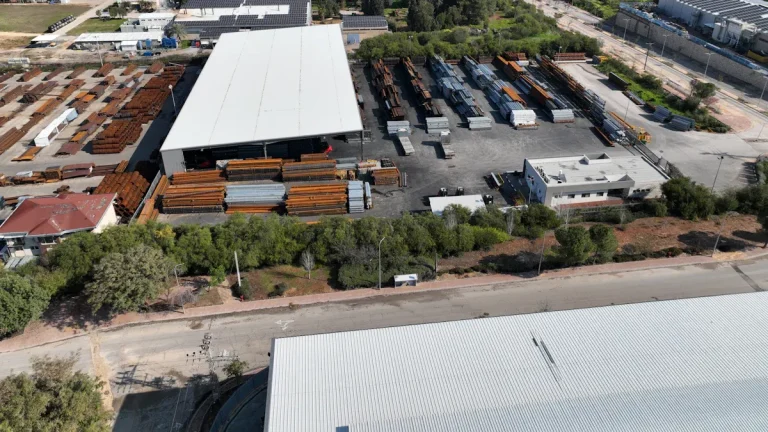
Shipping hazardous materials by sea is probably the most heavily regulated aspect of the whole logistics chain worldwide. Even the ship is just one part; the entire chain of events, including packaging labelling etc. must conform to international standards. The 20FT dangerous goods container is the industry standard for the safe transport of classified hazardous cargo through multimodal supply chains.
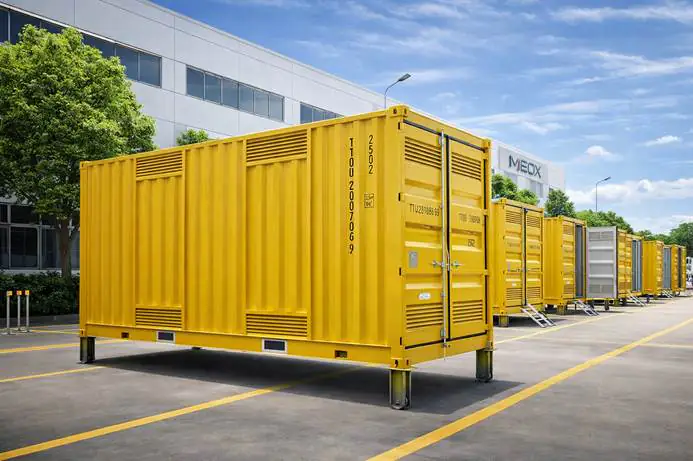
This article also discusses the main specifications, safety design features, regulations that affect it, and practical issues for the person who is considering a dangerous goods container for his or her operations.
What Is a 20FT Dangerous Goods Container?
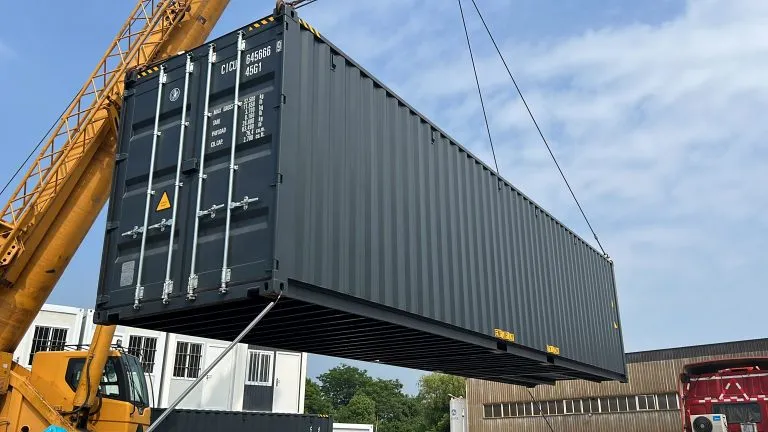
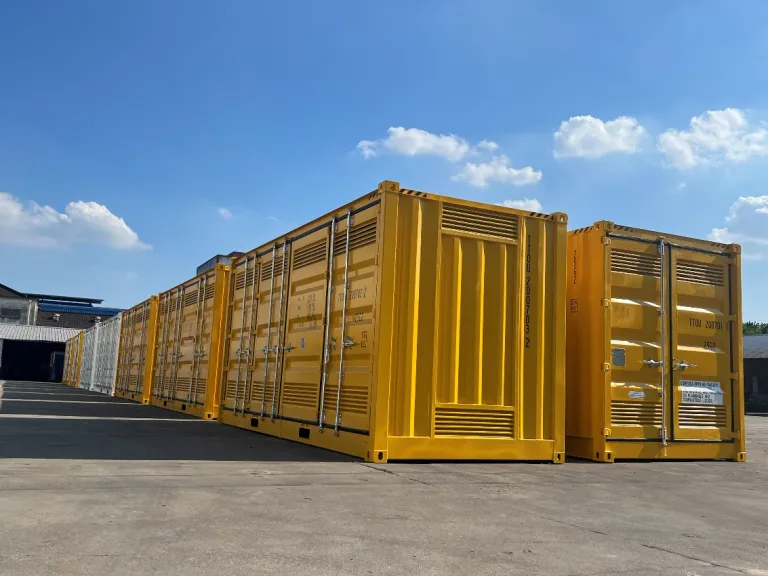
A 20FT dangerous goods container, also called a DG container or hazmat container, is an intermodal unit that has, in particular, been designed to transport safely hazardous materials that have been classified. A typical container for dry cargo does not have features like a means to contain leaks, a supply of fresh air through ventilation that can be increased, structurally upgraded strong quarters, and the use of safety equipment which is certified.
By having a defined 20-foot dimension (20′ × 8′ × 9’6″), it is possible for this type of container to be used with cargo ships, flatbed vehicles, and railway wagons anywhere in the world. Such compatibility matters a lot In particular for those bringing chemicals, flammable liquids, agents capable of destroying metals or even poisonous materials from one country to another.
Technical Specifications at a Glance
Below is a table providing a summary of the key weight and capacity figures for the standard 20FT DG container:
| Specification | Metric | Imperial |
| Max. Gross Weight | 12,000 kg | 26,455 lbs |
| Tare Weight (±2%) | 3,350 kg | 7,385 lbs |
| Max. Cargo Weight | 8,650 kg | 19,070 lbs |
| Cubic Capacity | 35.1 m³ | 1,241 ft³ |
| Exterior Dimensions | 20′ × 8′ × 9’6″ | 6.1 × 2.4 × 2.9 m |
Regulatory Framework: What Governs Dangerous Goods Transport?
Before selecting or deploying a DG container, it is important to understand the compliance landscape. Two frameworks cover most of the global needs –
The International Maritime Dangerous Goods (IMDG) Code is a set of rules for sea transport, which is the principal legally binding document in the transport of dangerous goods by sea. It was made to be an international code for the shipment of dangerous goods by sea, including aspects like packing, container traffic, and stowage, as well as the segregation of incompatible substances. (IMO, 2024)
ISO 16106:2020 states that the manufacturers of packaging and containment equipment for dangerous goods should implement a quality management system which meets certain criteria. Usually, the verification of the manufacturer’s compliance with this standard is performed independently by a body such as TÜV, which attests to the structural integrity, fire safety measures and containment abilities.
On top of that, these two standards states that any hazardous material container which is compliant with ISO 16106 requirements at the design stage and manufacturing stage shall undergo both structural testing and a quality system audit before being certified for hazmat transport.
Hazard Class Compatibility
It is impossible to carry all types of dangerous goods in a single container. As the IMDG Code, hazardous substances are divided into nine classes. This table lists the classes permitted to be shipped in a standard 20FT DG container:
IMDG Hazard Class Compatibility
| Class | Category | Compatibility |
| Class 2 | Gases (non-explosive) | Compatible |
| Class 3 | Flammable Liquids | Compatible |
| Class 4 | Flammable Solids | Compatible |
| Class 6 | Toxic & Infectious Substances | Compatible |
| Class 8 | Corrosives | Compatible |
| Class 1 | Explosives | Not Compatible |
Note: Always verify IMDG Code segregation rules before loading mixed cargo. Class 1 explosives require dedicated, separately certified units.
Core Safety Features
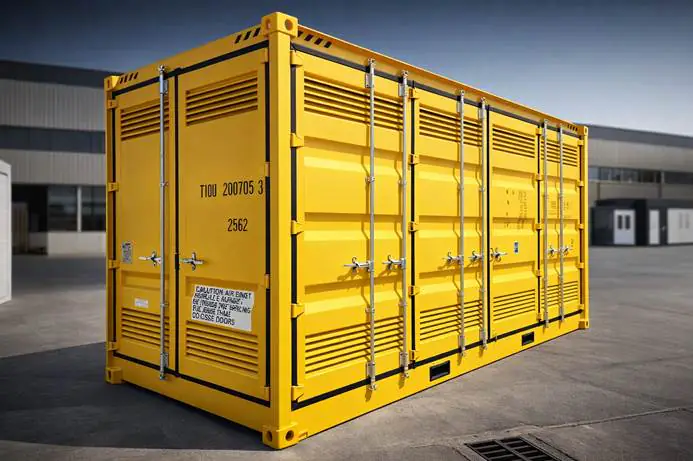
What makes a purpose-built DG container stand out from a modified standard unit is the collection of professionally designed safety features. A good 20ft hazmat shipping container for chemicals shipping should be equipped with each of the following:
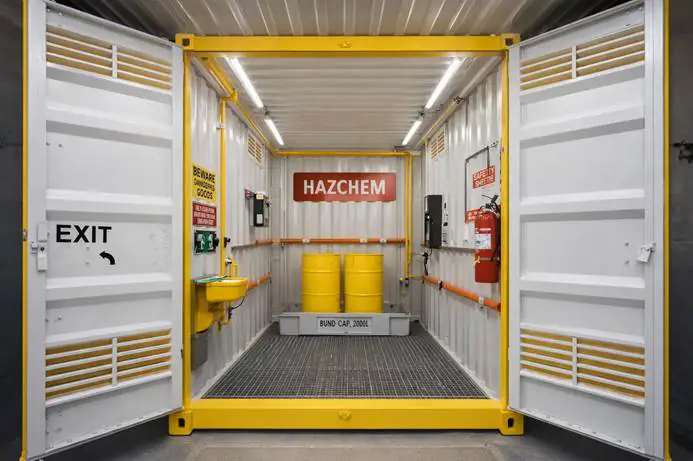
- Spill-Containment Bunded Floor: Liquid spills are captured by a raised lip enclosing the floor perimeter, thereby avoiding the contamination of the soil during loading, unloading, or accidental release.
- Chemical Drainage Valve: The capability to control and safely discharge collected liquids is a must – whether it be emergency response or routine cleaning.
- Dual Side-Access Doors: Improves cargo accessibility for drums, IBCs and palletized loads. Side entry minimizes the need to stack items deep and allows for easier inspection.
- Emergency Escape Hatch: Personnel safety regulations require providing a second escape way that does not rely on the main door, in case the unit is engulfed by fire or a hazardous release.
- Reinforced Locking Bars and ISO Corner Castings: Maintain structural integrity when stacked and secure lashing to vessel deck fittings.
- DG Placard Rails: Custom holders for the mandatory hazmat identification placards, to satisfy IMDG and ADR marking needs.
Safety Feature Summary
| Safety Feature | Function | Compliance Standard |
| Spill-Containment Bunded Floor | Captures chemical leaks | IMDG Code / ADR |
| Chemical Drainage Valve | Safe liquid discharge | ISO 16106:2020 |
| Dual Side-Access Doors | Safe loading/unloading | ISO 668 |
| Emergency Escape Hatch | Personnel evacuation | TÜV Certified |
| Reinforced Locking Bars | Cargo security in transit | ISO Corner Castings |
Multimodal Transport Considerations
The 20FT DG container format’s biggest advantage, in fact, is that it is well-suited for multimodal transport. ISO corner castings allow the goods to be transferred from ship to truck and from truck to rail without unloading. It’s In particular valuable for hazardous goods because every time a cargo is transferred, there is a risk event.
HZ Containers in their regulatory overview specify that a shipment needs to be accompanied by a correctly filled IMO Dangerous Goods Declaration (DGD) in which the shipper confirms that the goods are packed, marked, and prepared in line with the IMDG. The person who personally loaded the container must also sign a Container/Vehicle Packing Certificate. (HZ Containers, 2026)
For a sea voyage only, it is the duty of operators to ensure that the cargo’s stowage category is accurately indicated for example, SW2 (deck-only) cargo has different placement requirements than SW1 below-deck cargo.
Real-World Application: Chemical Distributor Deployment in Southeast Asia
The Challenge
Southeast Asia’s independent regional chemical distribution company had the need to send Class 3 (flammable liquids) and Class 8 (corrosives) products simultaneously on a multi-port route including Singapore, Jakarta, and Ho Chi Minh City. Their current regular containers had no bunding or drainage systems, making them potentially non-compliant and risky for port clearance under IMDG segregation rules. Besides, their logistics personnel wanted containers that had side-access doors so that the unloading of drums could be done efficiently at smaller ports which had limited crane access.
The Solution
MEOX delivered a set of 20FT dangerous goods containers specially tailored to the cargo profile of the client. The features of each container included double side-access doors, a chemical-resistant floor that was fully bunded with a drainage valve, and TÜV-verified ISO 16106:2020 certification. For IMDG-compliant identification, the exterior was equipped with custom DG placard rails. The containers were able to pass port inspections at the three locations without any issues, and the client was able to get rid of the compliance penalties that they had been incurring with standard units.
Choosing the Right DG Container for Your Cargo
The choice of a 20FT ISO 16106-certified dangerous goods container should be based on the following:
- Hazard class and segregation requirements: Verify that the goods you are carrying are suitable for a single unit load and do not require to be separated under IMDG rules.
- Payload density: Chemicals and other industrial fluids usually have a high specific gravity. Please first check that the unit’s max cargo weight (8,650 kg) is sufficient or ask about higher capacity options.
- Access configuration: Where drum or IBC handling is involved and where forklift access is limited at destination, dual side doors are preferred.
- Certification documentation: Always ask for TÜV or other equivalent third-party test certificates before the deployment. Port authorities in most SOLAS member states will demand these.
Frequently Asked Questions (FAQs)
What is the difference between a standard shipping container and a dangerous goods container?
A standard container shall be for general dry cargo only and shall not include features such as spill containment, drainage or emergency escape routes. But a dangerous goods container is equipped with several safety features, including a bunded floor, chemical drainage valve, reinforced locking bars, emergency escape hatch, and DG placard rails. In addition, it is subject to independent certification – usually to ISO 16106:2020 – which verifies that it complies with the structural and safety requirements of the IMDG Code.
Can a 20FT DG container be used for both Class 3 and Class 8 cargo simultaneously?
This naturally depends on the substances involved and their respective IMDG segregation requirements. According to IMDG regulations, some Class 3 and Class 8 chemical combinations can be placed in one container via different methods and others require segregation. Therefore, prior to organizing a co-load, you should review both the separations table found in the IMDG Code as well as an MDSD for every product you are shipping. As a precaution, keep all class of goods in separate containers unless you can determine how they can be co-loaded.
What documentation is required to ship dangerous goods in a 20FT DG container by sea?
You must have the following documents at a minimum to move classified Cargo: a completed IMO Dangerous Goods Declaration (DGD). The DGD must be signed by the shipper, and you need a Container/Vehicle Packing Certificate that’s signed by the person who packed the container. You’ll also require a MSDS for each chemical being transported and any necessary tank/type approval certificates needed for the containers from the packing materials’ manufacturers. Once you arrive in port, the authorities may require an ISO 16106 or a TV certificate for the containers.
Conclusion
The 20-foot dangerous goods container is an efficient and regulated way to safely store hazardous materials in one secure location. The 20’ container is an excellent investment for any business that transports dangerous materials; it has mobility, protects the environment from contamination and includes safety and all necessary regulatory support.
Ready to Source a Certified Dangerous Goods Container?
If your logistics process involves transporting hazardous materials of a classified nature, a customized and certified unit is absolutely necessary – it is the basis for meeting regulatory requirements and ensuring safety. MEOX produces and markets 20FT containers for dangerous goods compliant with ISO 16106:2020 and TÜV certified, and also offers 10FT Dangerous Goods Containers for smaller volume demands.
Contact MEOX today to discuss your cargo profile and receive a custom specification.
Disclaimer: The technical information, dimensions, configurations, and materials that were used as the basis for this article relate to dangerous goods container products from MEOX. Actual specifications, materials certifications, and technical details might be different due to project requirements, local regulations, and product customization.
Want to see how dangerous goods containers are designed and built? Watch our Dangerous Goods Containers Introduction video on YouTube