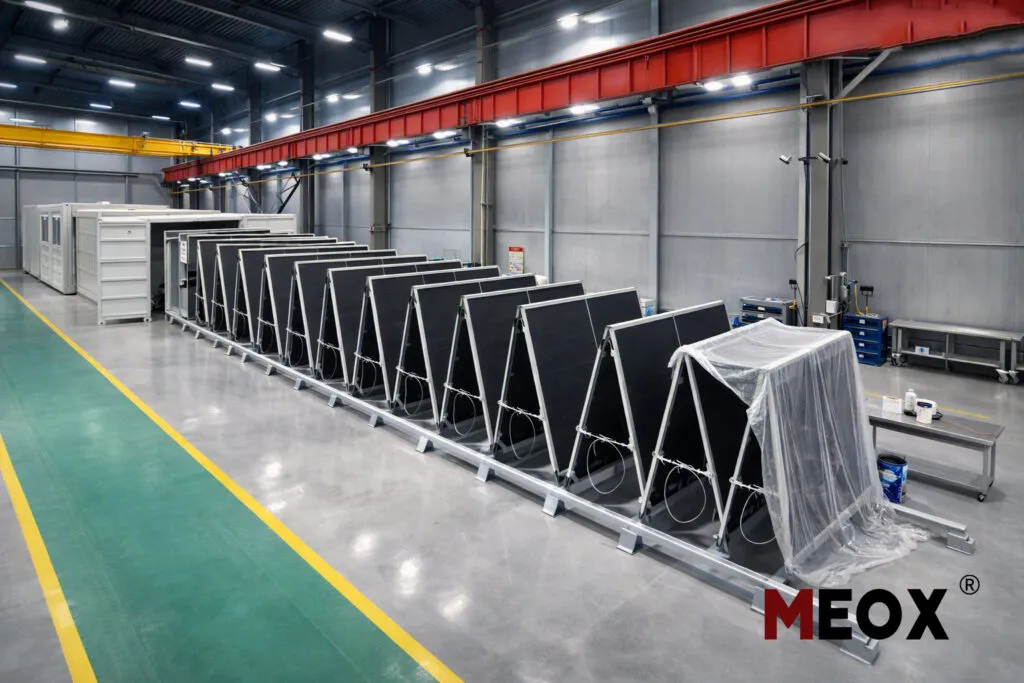
A mobile solar container is a factory-built, containerized power system that combines a folding solar array, battery storage, and an inverter into a single transportable unit — no on-site electrical installation required. For smaller remote loads, a full-size 20 or 40-foot unit is often more capacity than the site needs. A compact 10-foot format, like MEOX’s 10FT Mobile Solar Container, solves this by scaling the same folding-array technology down to a 24 kWp array and 32 kWh battery bank — enough for a single building, a telecom site, or a small work crew, without paying for capacity that will sit unused.
What Is a Mobile Solar Container?
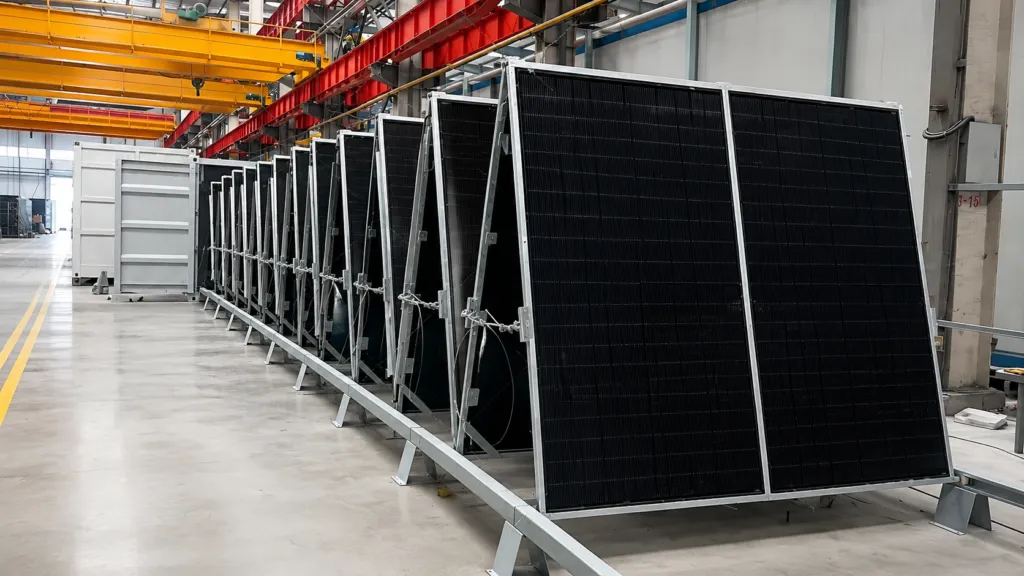
The concept behind every unit in MEOX’s energy storage container line is the same regardless of size: a shipping-container shell houses a rail-mounted solar array that folds flat for transport and unfolds on site into a full-scale power plant. Panels, wiring, combiner boxes, the inverter, and the battery bank all ship pre-assembled, so deployment is a matter of positioning the container and unfolding the array rather than running a construction project. The steel racking is hot-dip galvanized for corrosion resistance, and the battery chemistry — LiFePO4 across the range — is chosen for thermal stability in sealed, sun-exposed enclosures.
The biggest difference in this system compared with a traditional solar ground-mount is mostly about moving stuff. A traditional solar ground-mount system will take multiple resources and require time to be completed – site analysis, foundation or racking construction, separate wiring of panels with an inverter/battery room from electrical contractors, and in most cases, months of scheduled work before it can even produce your first kWh (electric). In contrast, a containerized unit can cut the time dramatically by doing that wiring, racking and electrical protection part at the manufacturer, so saving you lots of time and avoiding any installation errors. Obviously, the downside is that the size of the container and the degree to which it is tilted cannot be custom-designed but rather pre-fixed. Yet, in many places, the advantages of the quick and simple way to install a solar system outweigh having to have the array optimally oriented.
How the System Runs Day and Night
Once deployed, the system continues to run automatically without any need for turning it on manually. The solar panels are responsible for generating DC power during the day, which the combination inverter turns into a form of electricity that the building can directly use. Any excess is used for recharging the battery. Once the sun goes down, the inverter switches the load over to battery discharge automatically, drawing down the stored charge until sunrise restarts the cycle. Because the switching logic is built into the inverter, a site does not need an operator monitoring the system or manually starting a generator when the sun sets — it is the same automation used across MEOX’s 20FT and 40FT platforms, scaled to the smaller array and battery pairing of the 10FT unit.
Matching Container Size to Load
The most common mistake in specifying off-grid solar is sizing for the site’s land area rather than its actual power draw. A useful starting point is matching typical load profiles to container size:
| Typical Load Profile | Best-Fit Container Size |
| Small remote loads (sensors, security, small site office) | 10FT — 24 kWp / 32 kWh |
| Medium loads (telecom towers, work camps, small facilities) | 20FT — 113 kWp |
| Large or continuous loads (industrial sites, multi-building camps) | 40FT — 226 kWp |
Suitable container size is mainly about predicting the highest and lowest loads and then picking the biggest container that will handle the highest loads and leaving some margin. For example, you can go ahead and buy several small containers and have them set up in parallel or in several phases, which allows some degree of flexibility if your load is expected to increase at some point Then again, getting a container that is too big will have a real effect on your budget apart from the initial costs, a bigger container will require more land to be leveled and prepared, more personnel and a longer setup time, also for transportation, bigger formats need heavier and more elaborate logistics that smaller formats wouldn’t have to deal with For sites where there is really a small, constant load, 10FT formats tend to be more economical choices, even if faster deployment is not a factor in your selection.
A Typical Small-Site Deployment
Consider a remote telecom relay station or a small construction survey camp: a site office, a few lighting circuits, communications equipment, and maybe a well pump, drawing a modest and fairly predictable daily load with no grid connection nearby. Trenching in a generator fuel line or running a temporary grid extension is often slower and more expensive than the load justifies. A 10-foot solar container fits this scenario well; it arrives on a single flatbed, four workers unfold the array in about an hour, and the site has power the same day, running on solar through daylight hours and battery reserve overnight without a fuel delivery schedule to manage.
The economics shift compared to a diesel generator in a few specific ways. There is no recurring fuel cost or delivery logistics, which matters most for sites that are hard to reach or where fuel theft and spillage are ongoing concerns. There is also less noise and no exhaust, which can matter for sites near residential areas or with environmental permitting conditions attached. The main tradeoff is capacity: a generator can be sized arbitrarily large for a given budget, while a 10FT container’s output is capped at 24 kWp, appropriate for the load profiles above, but not a substitute for a generator on sites with heavy or unpredictable peak draw.
This kind of scenario is illustrative of the use case the format is designed for, rather than a specific deployment — actual sizing and configuration should be confirmed against a site’s real load profile.
10FT Mobile Solar Container: Specifications at a Glance
| Specification | 10FT Mobile Solar Container |
| Solar Array Capacity | 24 kWp — N-Type i-TOPCon, 48 modules |
| Battery Storage | 32 kWh LiFePO4 (2 × 16 kWh Dyness Power Brick Plus) |
| Total Weight | 4 tons |
| Deployment Time | 60 minutes to unfold, 30 to fold, 4-person crew |
| Operating Range | -30°C to +60°C |
| Certification | TÜV tested, CE-certified |
Maintenance Expectations
Because the array folds back into the container shell and the electrical components stay housed inside, routine maintenance is lighter than a typical ground-mount system. In practice, this means periodic panel cleaning where dust accumulation is heavy, a visual check of rail and bracket hardware after severe weather, and battery management checks that the hybrid inverter largely handles automatically. Solar modules are generally rated for 25-30 years of service life with gradual output decline, while LiFePO4 battery packs are rated for several thousand charge cycles before capacity drops meaningfully — in practical terms, years of daily use before a battery swap is needed. Because the battery and inverter are modular components within the container, capacity upgrades or replacements typically do not require replacing the racking or container structure.
Certification and Build Quality
Solar modules used across the MEOX range, including the 10FT format, are TÜV tested and CE-certified. Independent certification bodies such as TÜV Rheinland test PV modules against IEC 61215 for design qualification and IEC 61730 for electrical safety, confirming that modules hold their rated output and pass structural testing before carrying the mark (TÜV Rheinland, PV module testing). For containerized systems deployed in remote or harsh environments, that third-party verification matters more than it would for a rooftop installation with easy access for repairs.
Why Compact Off-Grid Formats Are in Demand
The market for off-grid and containerized solar has been expanding alongside growth in remote mining, telecom, and rural electrification projects. Industry analysis puts the global off-grid solar market at roughly USD 5.8 billion in 2026, with projections to more than double by the mid-2030s as battery costs fall and remote-site power needs grow (MarkWide Research, Off-Grid Solar Market). Compact, transportable formats are a meaningful part of that growth, since not every remote site needs — or can accommodate — a full ground-mount array.
FAQs
Q: How is a 10FT solar container different from a full ground-mount solar installation?
A: It ships pre-wired and self-contained, so deployment is largely a matter of positioning the container and unfolding the array, rather than a multi-week construction and permitting process.
Q: Can a 10FT unit power more than one small load?
A: Yes, within its 24 kWp / 32 kWh capacity. Multiple circuits can run off the system simultaneously as long as combined draw stays within that budget.
Q: What happens if a site’s power needs grow later?
A: Additional 10FT units can be added, or the site can move up to a 20FT or 40FT format — capacity scales directly with container size across the range.
Q: Does the system need a technician on site to operate it?
A: No. The hybrid inverter manages charging and discharging automatically, so day-to-day operation doesn’t require someone monitoring or manually switching the system.
Disclaimer: Specifications and figures referenced above reflect MEOX’s published technical data for the containerized solar range at the time of writing. Confirm current specifications and configuration options directly with MEOX before finalizing a project.